Zhenyuan Ancient City
Address
兴隆街21号
Description
🏯 Zhenyuan Ancient City
“Mountains stand fierce, rivers surge swiftly; the city rests in eastern Guizhou. One river cuts through the heart of the town, flanked by two mountains. Nine hills embrace a single city, one stream divides two administrative prefectures.”
——Classic description from the Guizhou Tongzhi (Comprehensive Gazetteer of Guizhou), Ming Dynasty
📍 Basic Information
- Full Name: Zhenyuan Ancient City (National Historic and Cultural Famous City)
- Location: Wuyang Town, Zhenyuan County, Qiandongnan Miao and Dong Autonomous Prefecture, Guizhou Province
(Note: No. 21 Xinglong Street is a representative historic courtyard within the core protection zone of the ancient city, part of the nationally protected "Zhenyuan Ancient Architectural Complex," but not a boundary coordinate for the city’s administrative limits. The actual area extends from the eastern bank of the Wujiang River to the foot of Shiping Mountain, covering approximately 2.5 square kilometers) - Protection Status:
- 🌟 Listed as one of the Second Batch of National Historic and Cultural Cities by the State Council in 1986
- 🌟 The "Zhenyuan Ancient Architectural Complex" designated as a National Key Cultural Relics Protection Unit in 2008
- 🌟 Selected among the Top Ten Most Charming Cities in China (as voted by China National Geography) in 2020
📜 Timeless History: A Thousand-Year-Old Military Stronghold and Strategic Gateway to Southwest China
The name "Zhenyuan" originated during the Yuan Dynasty (established as the "Zhenyuan Junmin Zongguan Fu" in 1279), but its urban history dates back to the fifth year of Emperor Gaozu of Han (202 BCE), when the county of Guqie Lan was established—the earliest administrative division in eastern Guizhou.
- Qin Dynasty's "Five-Foot Road" and Han Dynasty's "Zangke River" Access: The Wujiang River, serving as the golden waterway of the upper Yuan River, has been a vital land and water transportation hub since Qin and Han times, linking Central China through Hunan and Hubei into Yunnan and Guizhou.
- Prosperity in Ming and Qing Dynasties:
- In the 22nd year of the Hongwu reign (1389), the military fortress of Qinglong Cave was constructed, establishing the "Zhenyuan Wei" garrison with over ten thousand troops stationed there;
- During the Qing Dynasty, it ranked first among Guizhou’s Four Great Towns, alongside Lijiang (Yunnan), Langzhong (Sichuan), and Pingyao (Shanxi), recognized as one of China’s Four Great Ancient Cities. It also served as the central distribution hub for goods across five provinces—Yunnan, Guizhou, Sichuan, Hunan, and Guangxi, where "eight provincial guildhalls stood side by side, and tens of thousands of merchants gathered along the Wujiang River."
- Turning Point in Modern Times: In 1934, during the Long March, the Central Red Army passed through Zhenyuan, where Zhou Enlai, Zhu De, and other leaders held pivotal military meetings. The existing former residence of the Red Army (Peace Village site) is now a national base for patriotic education.
🏛️ Unique Layout: A Living Heritage of Integrated Mountain, Water, and City
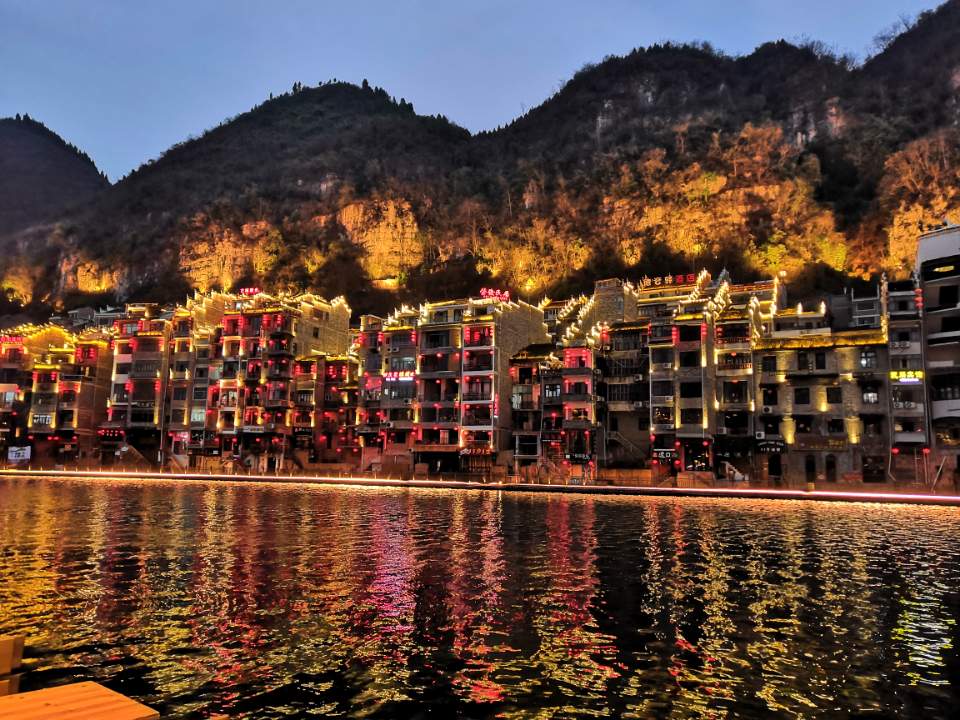
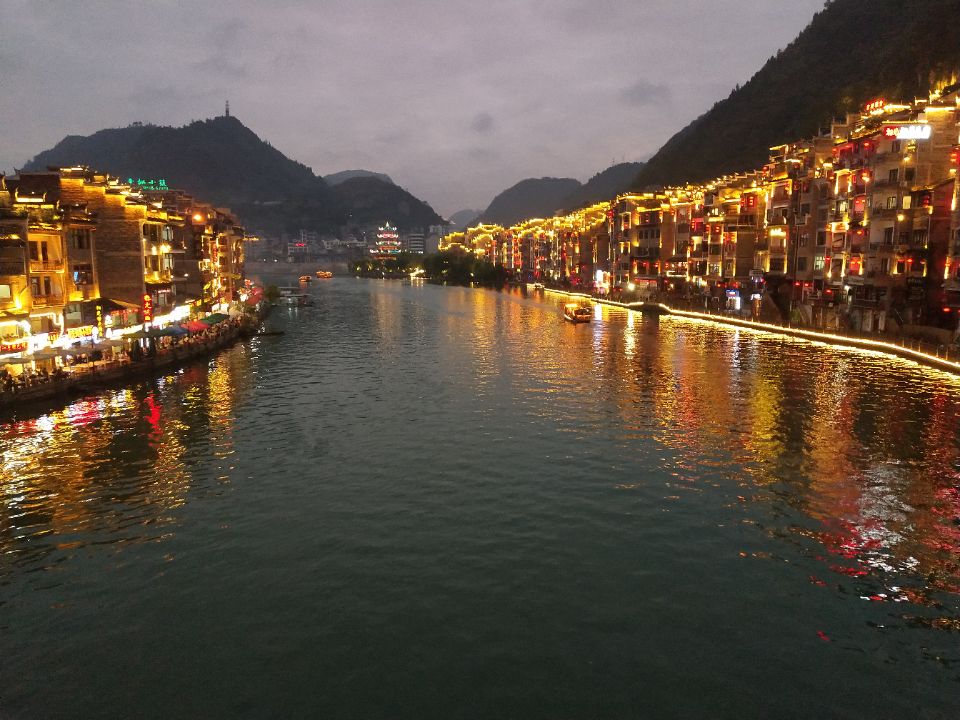
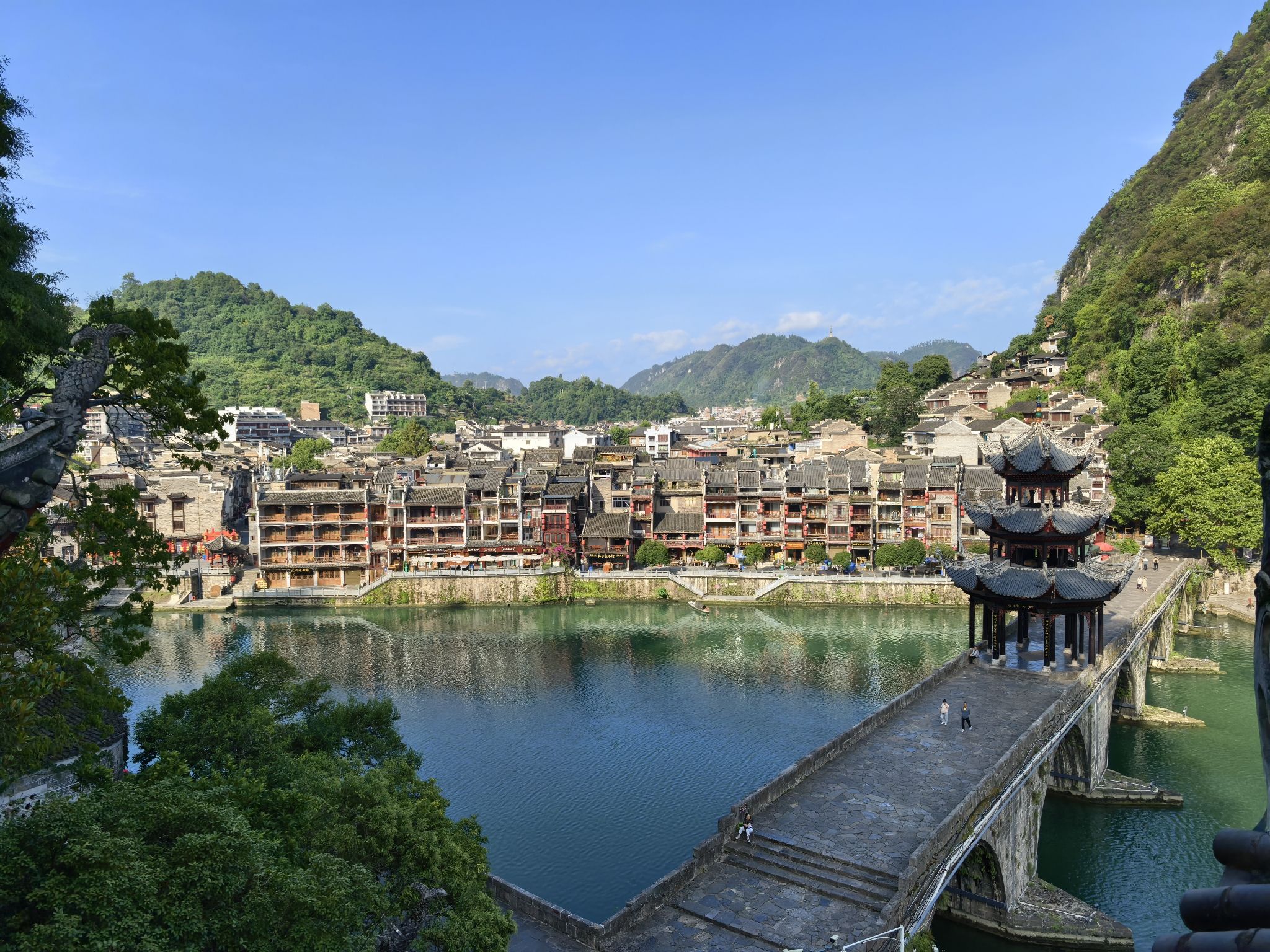
Zhenyuan Ancient City features an exceptional layout centered on the S-shaped Wujiang River, forming the iconic pattern of “Nine Hills Embrace One City, One Stream Divides Two Prefectures” (historically under the jurisdiction of Huguang and Guizhou Provinces)—a model of ancient mountainous city planning in China:
| Feature | Description | |----------------|-----------------------------------------------------------------------------| | Built Along Natural Terrain | City walls follow the contours of Shiping Mountain and Tianhou Mountain, with over 2 km of surviving Ming Dynasty wall segments visible, showcasing clear rammed earth construction with stone facing | | Built Along the River | Well-preserved ancient wharves remain functional: including Zhusheng Bridge Wharf, Chongzi Kou Wharf, and Shuncheng Street Wharf, with twelve Qing-era wharves still retaining operational heritage | | Street and Alley Fabric | The complete “Nine Streets and Eight Alleys” layout remains intact: main streets such as Xinglong Street, Renshou Street, and Si Fang Jing Street preserve their Ming-Qing dimensions; cobblestone paths are 1.8–3.2 meters wide, with staggered horse-head walls on either side, and door lintels inscribed with phrases like “Agriculture and Learning Pass Down the Family Line” and “Integrity and Kindness Build the Home” still visible |
🏯 Core Heritage Architectural Complex (National Key Cultural Relics Protection Unit)
- Qinglong Cave Architectural Complex (originally built in the Jiajing era of the Ming Dynasty):
- ⛩️ Unique Coexistence of Confucianism, Buddhism, and Taoism: The Zhongyuan Chan Temple (Buddhist), Ziyang Academy (Confucian), and Qinglong Cave Taoist Temple are stacked along the cliffside, with cantilevered wooden structures extending up to 12 meters—earning it the title of “Southern Sky Temple.”
- 📜 Over 27 Ming and Qing inscribed steles survive, including the Ming-era Record of the Reconstruction of Qinglong Cave and the Qing-era Regulations Stele of Ziyang Academy, offering invaluable historical records.
- Zhusheng Bridge (built during the Wanli era of the Ming Dynasty, rebuilt in the Kangxi era of the Qing Dynasty):
- 🌉 Spanning 135 meters with seven stone arches, the bridge features the Kuixing Pavilion at its center—its flying eaves and upturned corners soaring above the Wujiang River, making it the city’s iconic landmark.
- Tianhou Temple (built in the Yongzheng era of the Qing Dynasty):
- 🐉 The largest Mazu temple remaining in Guizhou Province, constructed by merchants from Fujian and Guangdong, featuring exquisite ceiling murals depicting the “Twenty-Four Filial Exemplars” and intricate brick carvings illustrating “Fisher, Woodcutter, Farmer, Scholar.”
- Eight Major Guildhalls: Including the Jiangxi Guildhall (Wanshou Palace), Fujian Guildhall (Tianhou Temple), and Hunan Guildhall (Yu Wang Palace), these sites bear witness to cultural integration during the Ming and Qing periods.
🎭 Rich Culture: A Living Museum of Diverse and Harmonious Human Civilization
- Ethnic Integration:
- Eleven indigenous ethnic groups—including Miao, Dong, Tujia, and Gelao—have coexisted long-term with the Han Chinese, creating a unique folk culture characterized by Han cultural foundation enriched by Miao and Dong traditions.
- Intangible Cultural Heritage Preservation:
- 🥁 Zhenyuan Dragon Boat Racing (National Intangible Cultural Heritage): Held annually during the Dragon Boat Festival, featuring competitions among the “Forty-Eight Villages,” with drum beats echoing the military signals of the Ming Dynasty;
- 🪔 Baoting’s “March 3rd Festival” (Provincial Intangible Cultural Heritage): The largest agrarian sacrificial event in the northern Dong region;
- 🎨 Tujia Shamanistic Opera and Miao Ancient Songs continue to be performed live in surrounding villages.
- Enduring Intellectual Legacy:
- The Qing Dynasty’s “First Academy of Eastern Guizhou”—Ziyang Academy—produced renowned scholars such as Zheng Zhen and Mo Youzhi;
- In modern times, it nurtured outstanding figures including revolutionary leader Zhou Yiqun (Class of 1924, Huangpu Military Academy) and geologist Ding Daoheng.
🧭 Practical Travel Guide
🚆 Transportation Options
- High-Speed Rail: Take the train to Zhenyuan Station (about 5 km from the city center). Exit and take bus K1 or a taxi—just 10 minutes to reach the city.
- By Car: Exit at the “Zhenyuan” interchange on the Shanghai-Kunming Expressway; navigate to “Zhenyuan Ancient City Tourist Center.”
- Within the Ancient City: Motor vehicles are prohibited. Walking is recommended, or rent an electric sightseeing shuttle (¥15 per person per ride).
🏮 Opening Hours
- Open Year-Round: The ancient city streets are free to enter 24/7;
- Entrance Fees for Key Attractions:
- Qinglong Cave Architectural Complex: ¥60 per person (includes Zhongyuan Chan Temple, Ziyang Academy, and Qinglong Cave Taoist Temple);
- Tianhou Temple and Zhusheng Bridge: Free admission (Zhusheng Bridge is especially stunning after night illumination);
- Best Visiting Times:
- 🌸 Spring (March–May): Blossoms frame white-walled, black-tiled courtyards; ideal humidity levels;
- 🌙 Night Visit Recommended: Wujiang River Night Light Show (every evening from 7:30 PM to 10:00 PM), enjoy a boat ride to savor the “sound of oars and glow of lights on the Wujiang River.”
🍽️ Local Experiences
- Must-Try Local Delicacies:
- 🌶️ Dao Cai (one of Guizhou’s Three Famous Pickled Vegetables; recorded in the Zhenyuan Fu Zhi of Qianlong era as “Dao Cai originates from Zhenyuan, yellow in color, fragrant in taste”);
- 🐟 Sour Soup Fish (Miao-style red sour soup paired with fresh carp from the Wujiang River);
- 🍢 Niu Bie Hot Pot (a distinctive Dong specialty—must be reserved in advance).
- Hands-On Craft Workshops:
- Learn traditional silver inlay techniques at the Miao Silvercraft Workshop on Si Fang Jing Street;
- Experience ancient bamboo weaving methods at the Zhenyuan Bamboo Weaving ICH Museum on Renshou Street.
🌟 Summary of Cultural Significance
Zhenyuan Ancient City is a three-dimensional textbook of ancient frontier governance wisdom, a living testament to the convergence of Yangtze River and Pearl River civilizations, and a spatial epic of China’s continuous, innovative, unified, inclusive, and peaceful cultural identity—written collectively by multiple ethnic groups. Its authentic, uncommercialized fabric, vibrant traditional festivals still breathing today, and time-honored craftsmanship passed down through generations make it a rare example worldwide of a living heritage site.
Sources: Zhenyuan County Annals (1991–2010), China Cultural Relics Atlas: Guizhou Volume, State Administration of Cultural Heritage 2023 Assessment Report on Zhenyuan Ancient City Conservation Status