Si Guan Temple (Xinglong Street, Northeast Corner of Zhenyuan Ancient City)
Address
兴隆街镇远古城(东北角)
Description
🏯 Si Guan Temple (Xinglong Street, Northeast Corner of Zhenyuan Ancient City)
📜 Historical Development
Located in the northeast corner of Zhenyuan Ancient City on Xinglong Street, in Qiandongnan Miao and Dong Autonomous Prefecture, Guizhou Province, Si Guan Temple was originally constructed during the Wanli period of the Ming Dynasty (circa 1573–1620). It is one of the prominent Taoist temples within the former Zhenyuan Prefecture. The name "Si Guan" derives from its veneration of four major Taoist deities—Heaven Official, Earth Official, Water Official, and Fire Official (some sources suggest a combination of the three officials with the Wenchang Emperor, or local syncretic integration with the Fire Deity). This reflects the popular religious phenomenon of “three religions converging, divine teachings guiding society” prevalent in eastern Guizhou during the Ming and Qing dynasties. The temple underwent multiple renovations during the Kangxi and Qianlong reigns of the Qing Dynasty, most notably documented in the Inscription on the Rebuilding of Si Guan Temple dated the 29th year of Qianlong (1764), which meticulously records donor lists and reconstruction history. This inscription serves as crucial physical evidence for studying religious activities and social networks in southwestern China during the Qing Dynasty. In the Republican era, the temple briefly served as a primary school. In 1982, it was included in the list of Guizhou Provincial Cultural Relics Protection Units as part of the overall Zhenyuan Ancient City. In 2006, it was designated by the State Council as a National Key Cultural Relics Protection Unit (Sixth Batch) as part of the “Ancient Architectural Complex of Zhenyuan.”
🏗️ Architectural Layout and Features
Facing south with its back to the north, the temple is built following the natural terrain, covering approximately 860 square meters. It exemplifies the typical wooden courtyard architecture of eastern Guizhou, blending central Chinese design principles with the ingenuity of the Miaoling region:
- Overall Layout: A three-part courtyard complex comprising a mountain gate, front hall (Lingguan Hall), main hall (Si Guan Hall), rear hall (side hall), and side wings, arranged symmetrically along a central axis with distinct hierarchical layers;
- Structural Techniques:
- The main structure employs a dou-gu (post-and-lintel) wooden framework, with green stone carved drum-shaped bases; some beams and lintels still bear traces of Qing Dynasty polychrome paintings;
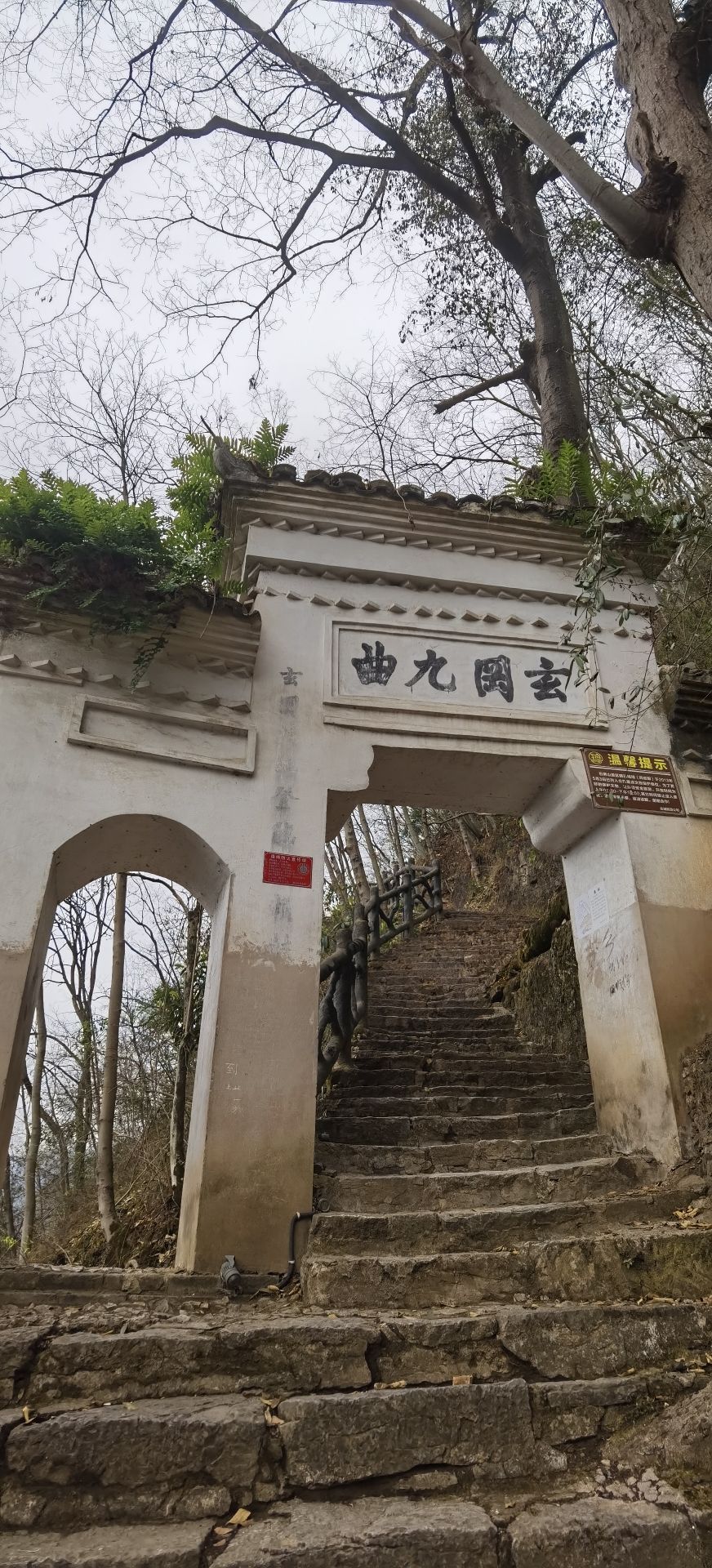
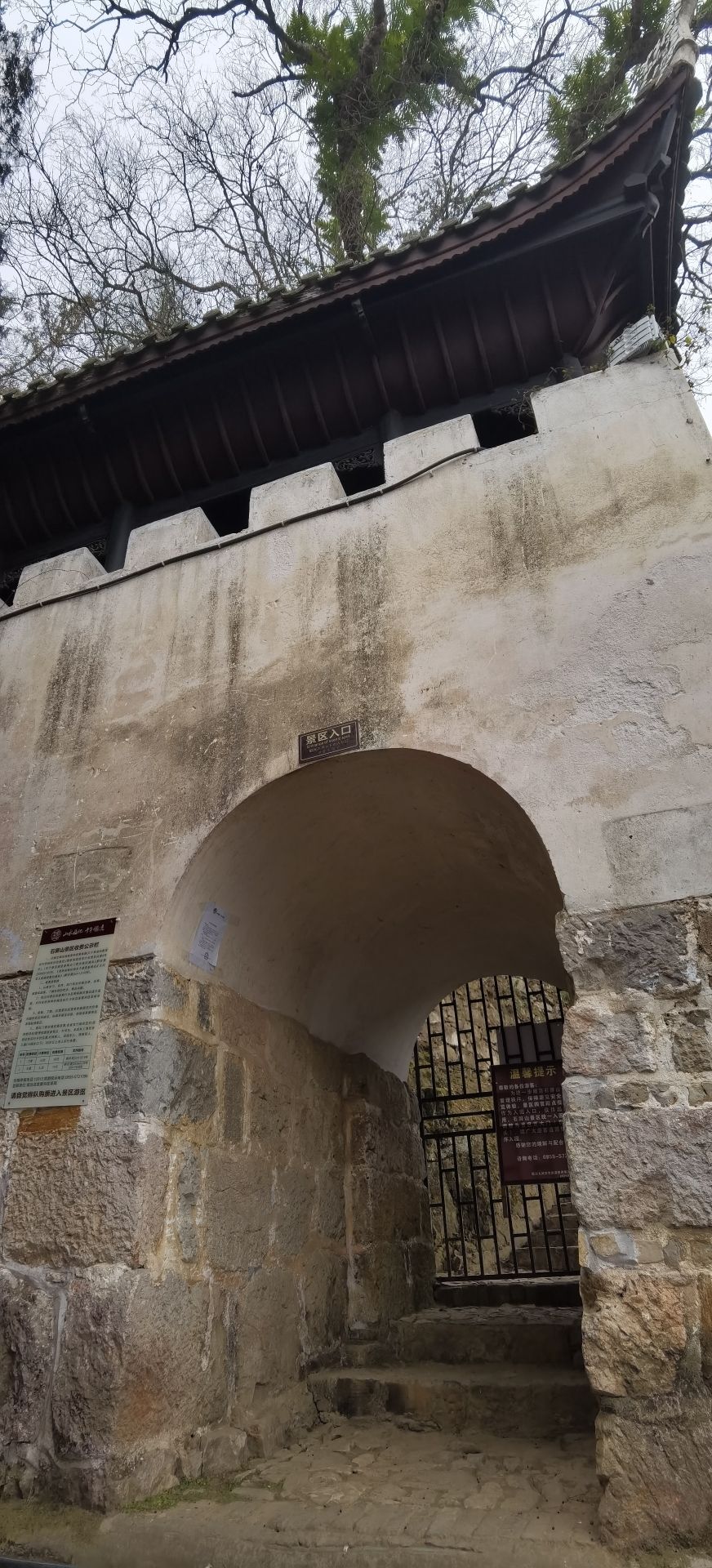
- The mountain gate features a hip roof with horse-head walls, tiled with gray tiles, eaves slightly upturned, and walls finished with white lime plaster adorned with ink-line outlines of the "Eight Immortals Crossing the Sea" motif in low relief;
- The main hall spans five bays wide and three bays deep, with six latticed doors in the central bay. The lattice pattern features the “endless ‘Wan’ character” design, symbolizing perpetual continuity;
- Environmental Integration: Situated east of the residual ridge of Shiping Mountain and west of a tributary of the Wujiang River, the temple’s foundation is built with locally quarried blue stone, while an intricate underground drainage system demonstrates ancient wisdom in “adapting to topography, utilizing natural defenses.”
🏺 Cultural Relics and Artistic Value
The temple houses precious historical relics that bear witness to centuries of religious tradition and evolving craftsmanship:
-
📜 Qing Dynasty Steles:
- Inscription on the Rebuilding of Si Guan Temple (29th Year of Qianlong, 1764): Inscribed in regular script, this stele documents the reasons for reconstruction, lists contributing merchants from over ten regions including Baoqing (Hunan) and Jia’an (Jiangxi), and highlights the collaborative spirit and commercial culture of borderland communities;
- Prohibition Against Deforestation Stele (15th Year of Jiaqing, 1810): Reflects early grassroots ecological awareness, banning tree-cutting behind the temple, with violators required to pay fines for temple repairs.
-
🎨 Religious Sculptures and Decorative Arts:
- The main hall’s altar houses Qing Dynasty clay sculptures of the Three Officials—Heaven Official bestowing blessings, Earth Official forgiving sins, and Water Official relieving calamities. Though later repainted, they retain clear characteristics of Ming Dynasty facial modeling and Qing Dynasty costume details;
- Ink-drawn gold cloud and dragon patterns adorn beams and lintels, while fragments of ceiling decorations depict the Taiji Bagua (Yin-Yang Eight Trigrams), illustrating Taoist cosmology through spatial expression;
- Stone lions at the mountain gate are mid-Qing Dynasty works: male on the left, female on the right. The male lion treads a brocade ball, the female cradles a cub; their carving style is robust and unrefined.
-
📜 Historical Archives: The temple preserves a fragmentary handwritten copy of the Zhenyuan County Gazetteer – Rituals and Temples Section from the Republic era, explicitly recording “Si Guan Temple located on Xinglong Street, annually honored on the three Yuan Festival days,” confirming its official recognition as a sacrificial site.
🌟 Cultural Significance and Academic Value
- Living Testament of Religious History: Si Guan Temple is among the few surviving sites in Guizhou that fully preserve the “Four Officials” worship system, providing tangible proof of how Taoist “Three Officials Veneration” evolved locally in southwestern frontier regions—such as the incorporation of fire deity beliefs into the Miao people’s “hearth god” concept;
- Witness to Ethnic Integration: Inscriptions feature joint donations by Han, Miao, and Dong merchants, while woodcarvings blend Han auspicious motifs with early forms of Miao “Butterfly Mother” patterns, reflecting Zhenyuan’s historical role as a crossroads of cultures—“the key to Yunnan and Chu, the throat of Hunan and Guizhou”;
- Urban Spatial Landmark: As a vital component of Zhenyuan Ancient City’s religious architectural system—comprising “nine palaces, eight temples, three hermitages, four grottoes, two shrines, two halls, one temple, and one academy”—it forms an organic symbiotic relationship with the nearby Qinglong Cave Ancient Architecture Complex (a National Key Cultural Relics Protection Unit), creating a harmonious “mountain—water—city—temple” landscape. It stands as a living example for understanding the spatial organization of religious structures in frontier cities under the Ming Dynasty military garrison system.
🧭 Travel Information
- 📍 Location: Xinglong Street, Zhenyuan County, Qiandongnan Prefecture, Guizhou Province (northeast corner of Zhenyuan Ancient City, near the intersection of Renshou Lane and Xinglong Street)
- 🕒 Opening Hours: 08:30–17:30 daily (closed on Mondays for maintenance, except public holidays)
- 🎫 Admission Policy:
- Included in the Zhenyuan Ancient City Combined Ticket (¥80 per person), granting access to Si Guan Temple and 10 other protected sites within the city;
- Free admission for visitors aged 60 and above, children under 14, active-duty military personnel, and persons with disabilities upon presentation of valid identification;
- Daily visitor cap: 300 people. Recommended advance booking via the “One Code Travel Guizhou” platform.
- 🚌 Transportation Guide:
- From Zhenyuan High-Speed Railway Station → Ancient City: Take Bus Line 1 to “Xin Bridge” stop, then walk 5 minutes;
- Within the Ancient City: Proceed east along Xinglong Street from Zhusheng Bridge for about 300 meters until you reach the brick-walled horse-head wall courtyard.
- ℹ️ Tips:
- Flash photography is prohibited inside the temple to protect cultural relics and respect the sanctity of the religious site;
- Highly recommended to combine visits with Qinglong Cave (8-minute walk) and Zhou Dawen’s Former Residence (5-minute walk) to fully appreciate the coexistence of Confucianism, Buddhism, and Taoism in the ancient city;
- Traditional ceremonies are held annually on the 15th day of the first lunar month (Lantern Festival), seventh lunar month (Ghost Festival), and tenth lunar month (Winter Festival). Guided tours can be booked in advance by phone at least three days prior.