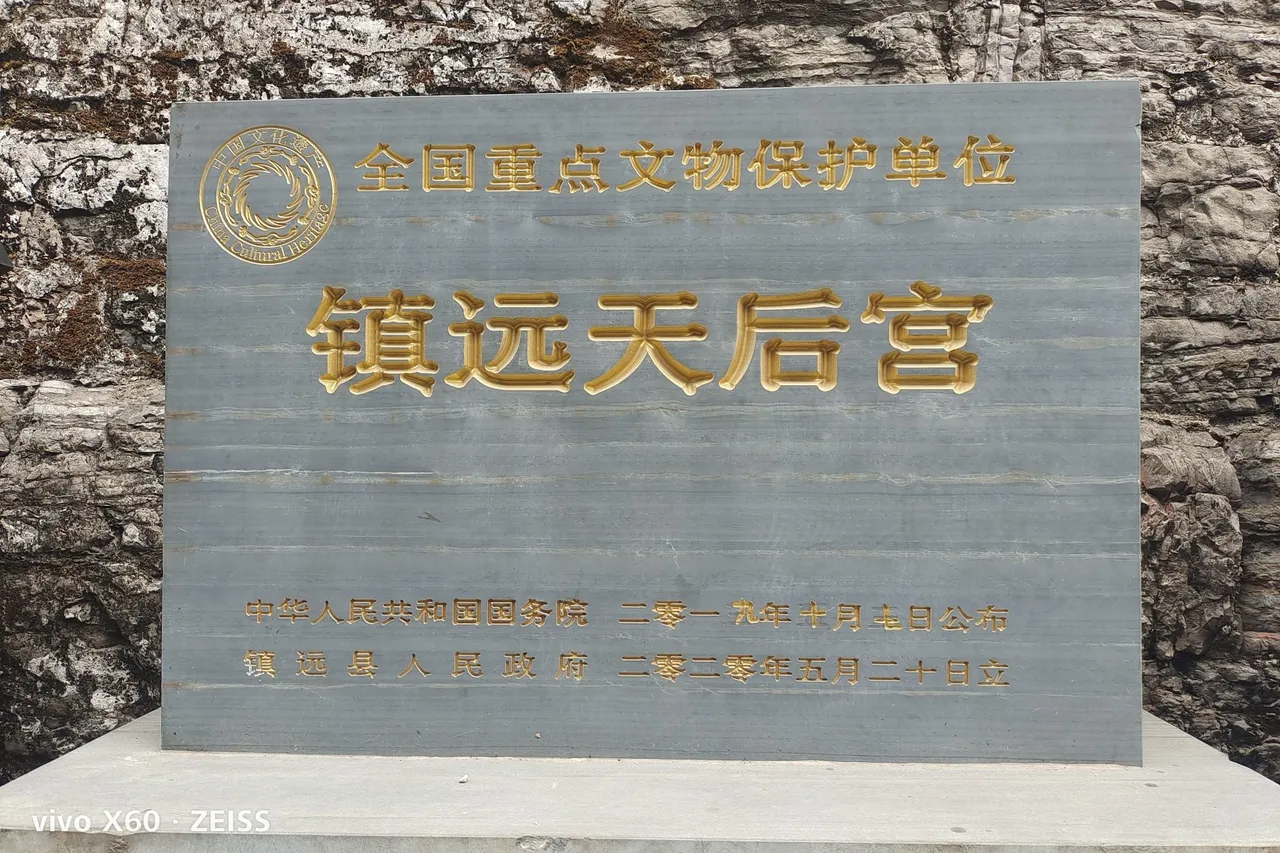
Zhenyuan Ancient City · Tianhou Temple
Address
兴隆街21号镇远古城(东北角)
Description
🏯 Zhenyuan Ancient City · Tianhou Temple
“Gateway to Eastern Guizhou, key to Yunnan and Chu” — a rare surviving testament to Mazu worship in inland Southwest China, offering a living chronicle of the Ming and Qing dynasties’ river trade networks and cultural fusion between Hunan and Guizhou.
📍 Basic Information
- Address: No. 21 Xinglong Street, Zhenyuan County, Qiandongnan Miao and Dong Autonomous Prefecture, Guizhou Province (northeast corner of Zhenyuan Ancient City, adjacent to the eastern bank of Wuyang River)
- Opening Hours: 08:30–17:30 (open year-round, normal service during holidays)
- Ticket Policy: Included in the Zhenyuan Ancient City Combined Ticket (¥80 per person); eligible visitors may enjoy national-standard discounts with valid identification; no standalone ticket available for individual entry
- Recommended Visit Duration: 45–60 minutes
- Transportation Guidance: Easily accessible on foot (walk east along Xinglong Street from the central historic district for about 300 meters); motor vehicles prohibited within the ancient city area; recommended to take the scenic electric shuttle to the “Tianhou Temple Stop”
📜 Historical Origins
Built in the 27th year of Emperor Qianlong’s reign (1762), the Tianhou Temple was funded by merchants from Fujian Province and stands as the largest and best-preserved Qing-dynasty Mazu temple currently existing in Guizhou. Its construction reflects Zhenyuan’s pivotal role as a major commercial hub at the upper reaches of the Yuan River:
- 🌊 Strategic Waterway Hub: Situated at the confluence of the Wuyang River and the Qingshui River, Zhenyuan served as the primary route for transporting salt, tea, timber, and tung oil between Huguang and Yunnan-Guizhou during the Qing dynasty. Merchants from Fujian and Guangdong navigated upstream along the Yuan River through Chen Prefecture (modern-day Yuanling, Hunan) and Changde, leading to the establishment of eight major guild halls in the region
- 🏗️ Evidence of Religious Migration: Originally a coastal deity, Mazu worship was brought inland by Fujian traders, overcoming geographical barriers—a powerful illustration of how Qing-era cross-regional commercial networks reshaped spiritual life
- 📉 Historical Evolution: Destroyed during the Xianfeng era due to war, it was rebuilt in the third year of Guangxu (1877) by Fujian boat associations; used as a grain warehouse in the 1950s, preserving its main structural integrity; listed in 2006 as part of the National Key Cultural Relics Protection Unit “Ancient Architectural Complex of Zhenyuan”; fully restored in 2013 following strict “restoration in original style” principles
🏛️ Architectural Features
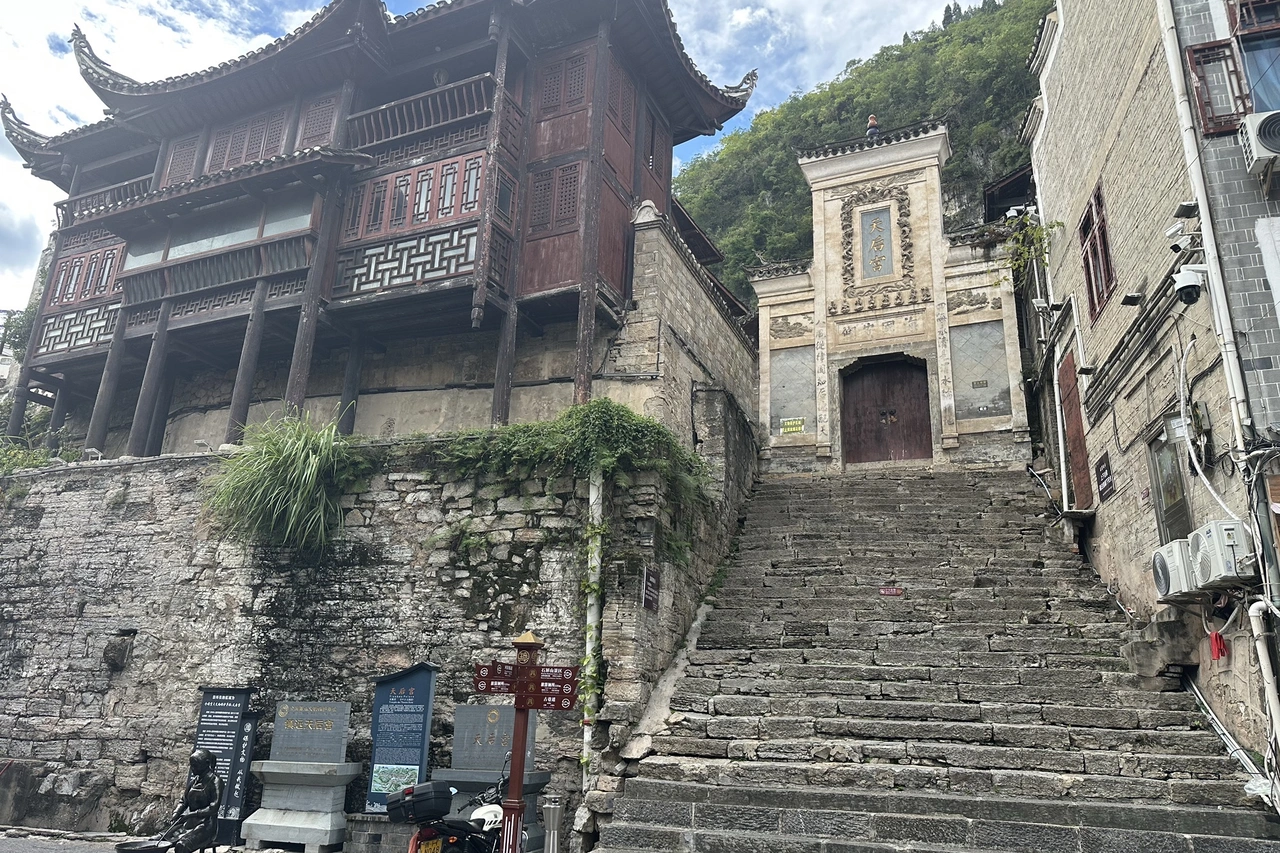
Spanning approximately 1,200 square meters, the temple blends typical southern Fujian architectural styles with local mountainous construction techniques, arranged across three courtyards that follow the natural slope of the terrain—exemplifying fengshui wisdom of “borrowing views from the Wuyang River, sheltering wind and gathering vital energy”:
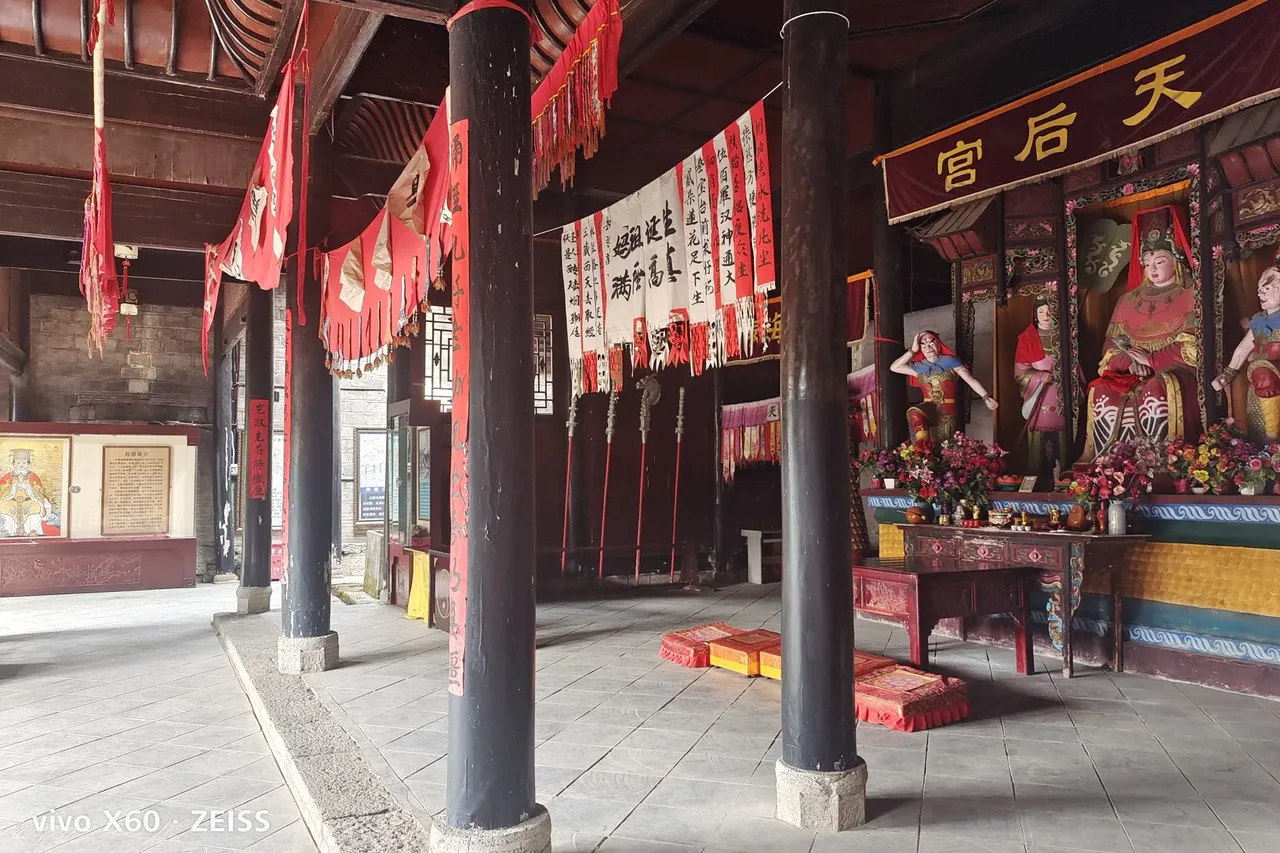
| Architectural Element | Description | |------------------------|-----------| | Mountain Gate | Brick-and-stone structure imitating wooden architecture, with a gabled roof; inscribed with a green stone plaque reading “Tianhou Temple”; flanked by two oblique screen walls decorated with gray clay carvings of the “Four Occupations: Fishing, Woodcutting, Farming, and Scholarship” | | Opera Stage | Double-eaved hip-and-gable roof, intricately painted ceiling depicting “The Eight Immortals Crossing the Sea”; a carved wooden plaque reading “Peaceful Rivers and Calm Seas” hangs above the stage opening (original from Guangxu period); stage base constructed using interlocking granite stones, featuring exceptional acoustics that carry sound clearly throughout the hall | | Main Hall | Timber frame with raised beams, five bays wide and three bays deep; enshrines a Qing-dynasty camphor wood statue of Mazu (2.3 meters tall, gilded and polychromed), discovered in 1982 behind the rear wall of the hall | | Back Hall (Guanyin Pavilion) | Two-story pavilion-style structure; ground floor dedicated to Guanyin, upper level originally a scripture repository; now houses a surviving copy of the Chronicles of the Imperially Enshrined Heavenly Empress (Guangxu-period carved edition, displayed as a reproduction) | | Ornamental Craftsmanship | ✦ Seven-tiered dougong brackets supporting eaves<br>✦ Beam and lintel surfaces adorned with gold lacquer wood carvings of “Hundred Sons” and “Carps Leaping Over the Dragon Gate”<br>✦ Hexagonal blue bricks laid in the courtyard, symbolizing “Six Harmony Bringing Prosperity,” reflecting merchant group values |
💡 Unique Value: Its Fujian-style cut-ceramic tile technique—using colored ceramic fragments to decorate ridge dragons and phoenixes—is unparalleled in Guizhou Province. Together with Anshun Confucius Temple and Guiyang Jiaxiu Tower, it forms a “triangular axis” representing the exchange of Qing-era craftsmanship in central Guizhou.
🏺 Key Cultural Relics & Exhibits
- Qing-dynasty Bronze Incense Burner (cast in the 42nd year of Qianlong): Weighing 42 kilograms, inscribed with “Presented by Merchants from Yongding County, Tingzhou Prefecture, Fujian Province”—the earliest confirmed physical evidence of Fujian merchants’ donation
- Stone Stele Inscribed “Record of the Restoration of Tianhou Temple” (Year 3 of Guangxu): Documents the names of contributing merchant guilds (including “Fuxing Shop” and “Wanchang Shop,” totaling 27 firms), confirming Zhenyuan’s status as a shared commercial governance center among merchants from Jiangxi, Fujian, Guangdong, Hunan, and Guizhou
- Long Scroll of Wuyang River Navigation Chart (reproduction): Based on hand-drawn maps from late Qing’s Comprehensive Records of Southern Guizhou, marking 32 river ports and tidal patterns from Zhenyuan to Changde—revealing the deep connection between Mazu worship and inland river transport safety
- Exhibition Room on Min-Gui Folk Interaction: Displays include a model of the “Fu Ship” used by Fujian merchants, a locally crafted bamboo shrine for Mazu from Zhenyuan, and repaired ceiling components made by Dong ethnic artisans—illustrating the process of religious localization
🌟 Cultural Significance & Academic Value
- Geographical Benchmark for Faith: One of the highest-latitude and farthest-inland Mazu temples in China (over 1,200 kilometers from the nearest coastline), challenging the traditional academic view that Mazu’s spread followed a strictly coastal trajectory
- Living Record of Merchant Guild History: The inscriptions preserve complete records of Qing-era inter-provincial merchant associations, fundraising systems, and self-regulatory codes—cited as a case study in History of Chinese Chambers of Commerce
- Model of Ethnic Architectural Integration: A creative fusion of southern Fujian timber framing with Guizhou’s local dougong construction methods—material proof of collaboration between Han craftsmen and indigenous Miao-Dong artisans
- Living Heritage Base for Intangible Culture: Every year on the 23rd day of the third lunar month (Mazu’s birthday), jointly organized with Zhenyuan’s Intangible Cultural Heritage Center, the “Wuyang River Sea Worship Ceremony” is held—integrating Fujian opera singing, Miao bronze drum performances, and Dong folk choral music, forming an essential component of the nationally recognized intangible heritage “Zhenyuan Dragon Boat Race”
🧭 Visitor Tips & Humanistic Suggestions
- ✅ Best Viewing Times:
- Early morning 08:30–09:30 (slanted sunlight illuminates the mountain gate, few visitors, ideal for observing intricate dougong details)
- After 16:00 (sunset casts golden light on the opera stage’s ceiling, reflecting like a cascade of stars)
- 📸 Photography Highlights:
- Composition of the mountain gate’s screen wall mirrored in the Wuyang River (requires clear skies and gentle breeze)
- Upward shot of the opera stage’s ceiling (recommended with wide-angle lens and tripod)
- Play of light through the latticed windows of the back hall (best with side sunlight in afternoon)
- 📚 Deep Experience Recommendations:
- Join the weekly Saturday 10:00 “Ancient Craft Workshop” (reservation required; experience Fujian-style gray clay stencil printing)
- Listen to the audio playback of Oral Histories of Merchant Guilds at the museum (collected from descendants in Yongding, Fujian, and Jiaoxi, Zhenyuan)
- ⚠️ Etiquette Guidelines:
- Flash photography and tripods prohibited inside the main hall (to protect painted layers)
- Respect spontaneous worship rituals; do not move incense burners or offerings
- Staircase in the back hall is steep; elderly visitors advised to proceed slowly
🌈 Closing Reflection: The Tianhou Temple is more than a sacred space—it is a living epic etched into blue bricks and black tiles, chronicling the commercial civilization of southwestern China. As Mazu’s compassionate gaze rests upon the emerald waves of the Wuyang River, we witness not only the miracle of a sea goddess journeying inland, but also how an ancient nation charted a vast course of cultural exchange—using faith as its vessel and commerce as its oars—carving a path of mutual understanding through towering mountains and winding rivers.