Tomb of Bian Que (Que Shang Village)
Address
鹊山东村
Description
🏯 Tomb of Bian Que (Que Shang Village)
“To this day, all those who speak of pulse diagnosis trace their tradition back to Bian Que.”
—— Records of the Grand Historian: The Biographies of Bian Que and Cang Gong
📍 Location and Basic Information
- Address: Que Shang Village, Xiaoli Subdistrict, Changqing District, Jinan City, Shandong Province (located at the northern foot of Mount Tai, south of the Yellow River, within the ancient Ji River basin)
- Protection Status: Provincial Cultural Heritage Site of Shandong Province (designated in 2013)
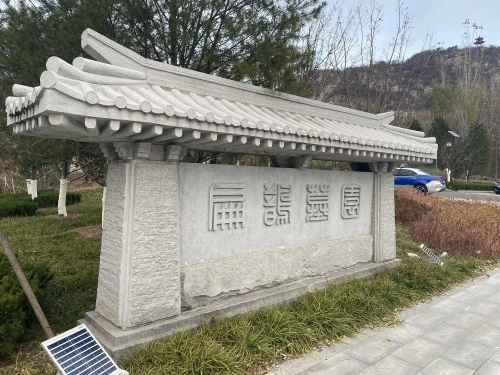
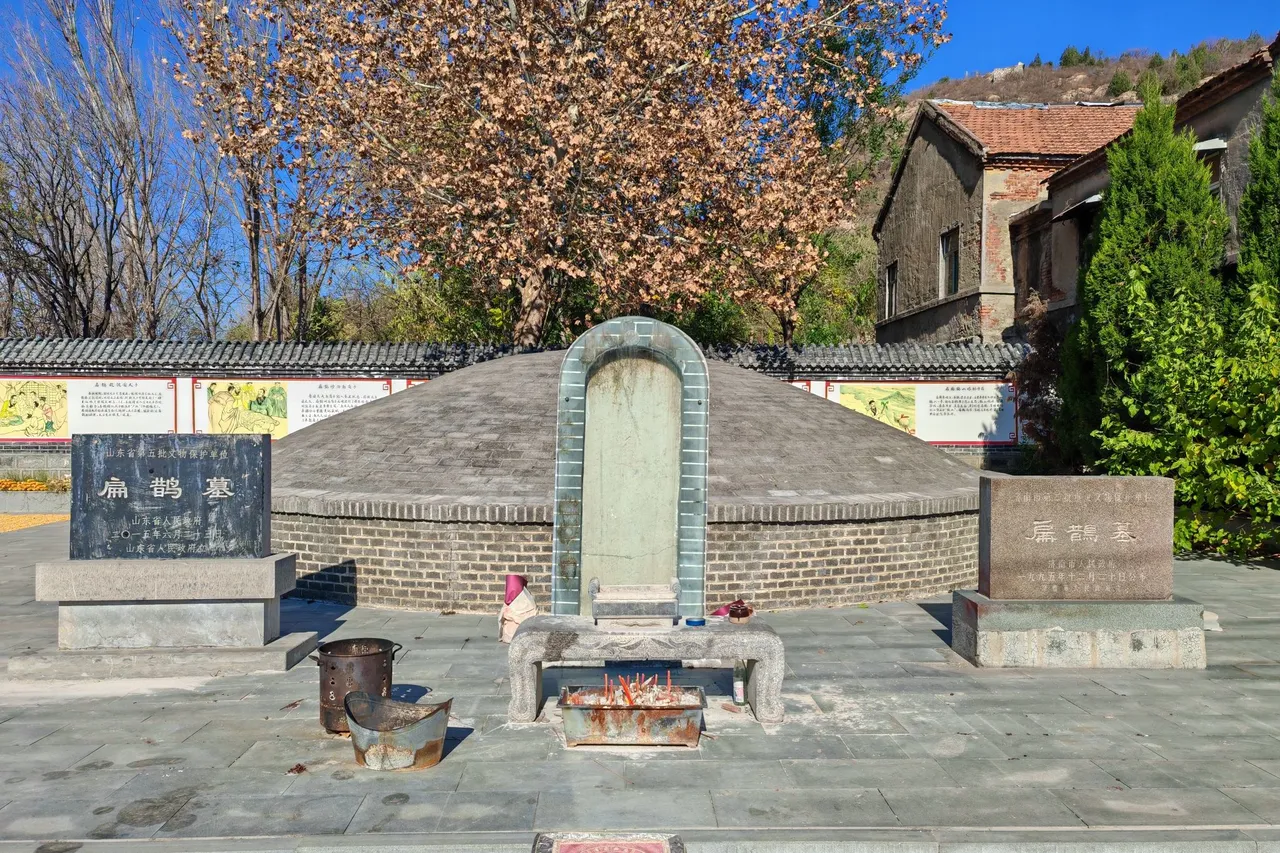
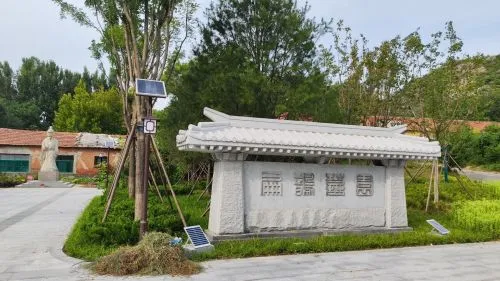
- Current Layout: The tomb park covers approximately 1,200 square meters, facing south with a north-south orientation, built into the natural slope of the hill. It preserves a Qing Dynasty-reconstructed tomb mound, inscribed steles, and associated ritual spaces.
📜 Historical Evolution: A Millennium-Long Resting Place for China’s Great Physician
Bian Que (c. 407–310 BCE), whose real name was Qin Yueren, was a renowned physician of the Warring States period and revered as the "Ancestor of Chinese Medicine" and "Founder of Pulse Diagnosis." According to the Records of the Grand Historian, he “passed through Handan, heard that women were highly valued, and became a specialist in gynecological disorders; went to Luoyang, learned that the people cherished the elderly, and served as an expert in ear, eye, and joint ailments; entered Xianyang, where children were beloved, and became a pediatrician.” His travels spanned numerous states, and his medical expertise and moral integrity were widely celebrated.
While the Records of the Grand Historian does not explicitly record his burial site, legends identifying the area around Que Mountain in Changqing as Bian Que’s ancestral home and final resting place have existed since the Han Dynasty. In the Commentary on the Waterways by Li Daoyuan of the Northern Wei Dynasty, it is written: “The Ji River flows northeast, passing west of the ruins of Lü County… then continues northeast past the foot of Que Mountain. At the mountain’s base lies the Temple of Bian Que, traditionally believed to be his residence—and also said to be his burial site.” This account was echoed in the Tang Dynasty’s Geographical Atlas of Yuanhe and the Ming Dynasty’s Comprehensive Geography of Historical Regions.
The current tomb mound dates from a major restoration led by Zhu Tingxiang, magistrate of Changqing County, during the 52nd year of the Kangxi Emperor’s reign (1713). A stele titled Record of the Rebuilding of the Tomb of Bian Que documents: “On the sunny side of Que Mountain stands an ancient tomb, still standing tall. Local elders have long passed down the tradition that this is the tomb of Bian Que. After years of decay, we now gather laborers and materials to restore it according to established standards…”
🏛️ Architectural Features and Cultural Relics
🪨 The Tomb Mound Itself
- Mound shaped like an inverted square pyramid, about 3.2 meters high with a base diameter of roughly 12 meters, constructed using rammed earth and encased in blue bricks (a remnant of Qing Dynasty renovations)
- In front of the tomb stand stone offering tables and incense burners; two Qing Dynasty stone lions flank the approach (weathered but still identifiable in form)
📜 Stele Collection (Core Cultural Relics)
| Stele Name | Era | Key Content | Significance | |------------|-----|-------------|--------------| | Record of the Rebuilding of the Tomb of Bian Que | 1713 (52nd Year of Kangxi) | Documents the reasons for reconstruction, donor lists, and local consensus affirming Bian Que’s burial here | ✅ Confirms official Qing recognition of the site; the earliest complete historical stele still extant | | Stele of Donors to the Rebuilding of the Tomb of Bian Que | 1903 (29th Year of Guangxu) | Records contributions by local gentry for the late Qing restoration | Reflects enduring folk traditions of veneration | | Modern Erected Stele: Tomb of Bian Que | 1985 | Commissioned by Shandong Provincial Bureau of Cultural Relics; inscribed in regular script, marking its status as a provincial cultural heritage site | Official legal protection marker |
🏯 Associated Remains
- The original Temple of Bian Que was destroyed in the mid-20th century; only foundation remains (located about 50 meters southeast of the tomb, visible are three column bases)
- Two ancient cypress trees survive within the park, each over 300 years old, their gnarled branches symbolizing enduring resilience and history
🌟 Cultural Value and Historical Significance
- Spiritual Landmark of Traditional Chinese Medicine: One of the few sites nationwide confirmed through a convergence of classical texts, regional gazetteers, and stele inscriptions as a memorial tomb of Bian Que, serving as a vital physical embodiment of the Chinese medicine tradition’s reverence for its origins.
- Symbolic Space of Ancient Medical Ethics: The tomb has long been a venue for reflecting on Bian Que’s “Six Non-Treatable Conditions” (pride beyond reason, valuing wealth over health, inability to regulate diet and clothing, imbalance of yin and yang, frail constitution unable to tolerate medication, belief in shamans over physicians)—a principle continuously interpreted and promoted through generations of rituals.
- Living Transmission of Qilu Regional Culture: Changqing still hosts the annual “Que Mountain Temple Fair” (around the 15th day of the fourth lunar month), during which villagers spontaneously pay homage, recite the Eulogy to Bian Que, and present moxa sachets made of mugwort—demonstrating deep-rooted popular recognition of the physician’s compassionate spirit.
- Paradigm of Archaeological and Literary Corroboration: The site aligns closely with descriptions in authoritative geographical works such as the Commentary on the Waterways and Complete Geographical Survey of the World, providing crucial empirical evidence for studying the spatial evolution of veneration for medical sages from Han to Tang times.
🧭 Traveler’s Practical Information
🚗 Transportation Guide
- By Car: From central Jinan → Jing-Tai Expressway (G3) → Changqing Exit → Provincial Road S104 → Xiaoli Subdistrict → Que Shang Village (approximately 45 km, about 1 hour drive)
- Public Transit: Take a bus from Jinan Long-Distance Bus Terminal to Xiaoli Town, then transfer to a local tricycle or walk about 3 kilometers (village roads are flat, with clear directional signs along the way)
🕒 Opening Hours
- Open Year-Round Free of Charge, daily from 8:00 AM to 5:00 PM (recommended to avoid rainy or snowy weather—the site lacks shelter)
- Suggested Visit Duration: 40–60 minutes (including detailed reading of steles and quiet reflection)
- Visitor Tips:
- The site is solemn and commemorative; please remain quiet and refrain from climbing the mound or touching the steles
- Nearby, visitors may explore the “Bian Que Well” (traditionally believed to be the source of water used by him, located in the western part of the village, with clear, fresh water)
- We recommend combining this visit with nearby attractions: Lingyan Temple (15 km away) and Guo Clan Tombs Stone Shrine on Xiaoling Mountain (China’s oldest surviving structure built above ground), ideal for a deeper cultural itinerary
📚 Recommended Further Reading
- Records of the Grand Historian: The Biographies of Bian Que and Cang Gong (Pointed and annotated edition by Zhonghua Book Company)
- Changqing County Annals (Qing Dynasty editions under Qianlong and Guangxu eras, reprint versions), Volume III: “Ancient Sites”
- Li Jingwei, A Brief History of Ancient Chinese Medicine (Science Press, 2021), Chapter Three: “The Sage Physician Bian Que”
🌿 A handful of earth holds profound healing wisdom; a thousand years of Que Mountain honors the great forest of medicine.
This place is more than a site of remembrance—it is a sacred origin point for questioning the essence of healing and cultivating reverence for life.