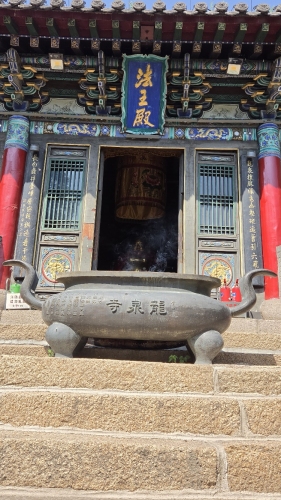
Hall of the Dharma King (within Longquan Temple)
Address
东南17公里龙泉寺内
Description
🏯 Hall of the Dharma King (within Longquan Temple)
"The Dharma King" is an exalted title for the Buddha; this majestic hall carries on a thousand years of incense and continues the cultural lineage of Shanxi Province.
📍 Location and Administrative Affiliation
- Affiliated Temple: Wutai Mountain Scenic and Historic Area, Shanxi Province · Longquan Temple
- Exact Location: Situated at the northern end of the central axis of Longquan Temple, approximately 17 kilometers southeast of Taihuai Town in Wutai County, Xinzhou City, Shanxi Province. The temple faces south and is built into the mountain slope according to natural topography.
- Geographic Coordinates: 38°52′ N, 113°36′ E (at the mouth of Longquan Gully, a branch of South Tai Mountain)
- Travel Tips: About a 30-minute drive from the center of Taihuai Town. Visitors may take the scenic area’s eco-friendly shuttle bus to the “Longquan Temple” stop and walk 50 meters to reach the site. Self-driving visitors must park in designated areas outside the temple grounds and enter on foot.
✅ Note: The Hall of the Dharma King is not an independent temple but one of the core structures within the Longquan Temple complex. It was originally constructed during the Ming Dynasty and finalized in its current form during the Qing Dynasty. It is an integral part of the "Ancient Architectural Complex of Wutai Mountain," a nationally protected cultural heritage site designated by the State Council in 2006.
📜 Historical Evolution
-
Founding Period (Ming Dynasty, around 1573–1620):
Longquan Temple was initially named "Longquan An" (Longquan Hermitage), derived from the nearby ancient, perennially flowing sacred Longquan Spring. At that time, the Hall of the Dharma King served as the main hall, enshrining the Mahāvairocana Buddha (Dainichi Nyorai), whose name signifies "King of the Dharma Realm," thus earning the name "Hall of the Dharma King." -
Prosperity and Reconstruction (Kangxi to Guangxu Periods, Qing Dynasty):
- In the 26th year of Kangxi's reign (1687), Lama Awang Laozang, the chief abbot of Wutai Mountain, led the reconstruction of Longquan Temple. The Hall of the Dharma King was expanded in a style blending Han and Tibetan architectural traditions, with new statues of the Five Tathāgatas and Eight Great Auspicious Goddesses added.
- In the 24th year of Guangxu (1898), Governor Hu Pengzhi of Shanxi Province donated funds for renovation. The roof was covered with peacock-blue glazed tiles, adorned with nine mythical beasts along the ridge—exceeding standard regulations—highlighting its exceptional status among Han Buddhist temples in Wutai Mountain during the Qing era.
-
Modern Conservation (20th Century to Present):
- In 1954, the Shanxi Provincial Cultural Relics Management Committee conducted scientific removal and reinforcement of the Ming Dynasty murals inside the hall;
- From 2012 to 2015, the National Cultural Heritage Administration allocated special funding for comprehensive restoration, strictly adhering to the China Principles for the Conservation of Cultural Heritage Sites. All original wooden frameworks, painted layers, and stone foundations were preserved intact;
- Today, it remains the only Han Buddhist hall in Wutai Mountain that fully preserves the overlapping beam structure from both the Ming and Qing dynasties.
🏛️ Architectural Artistic Features
| Feature | Description | |--------|-------------| | Form and Layout | Single-eaved gable-and-hip roof, five bays wide (18.6 m), three bays deep (12.4 m), total height 14.2 m. A front moon platform, 12 m wide, features a blue stone lotus base railing carved with the "Eight Treasures" motif | | Woodwork Craftsmanship | Roof truss follows the typical Ming-era "six-rafter roof with front and rear dougong supported by three columns." The main pillars rise to 9.8 m. The bracket sets are five-tiered double-prowed, with two decorative units per bay; the projecting brackets are shaped like lute surfaces, reflecting characteristic features of official architecture in northern Shanxi during the Ming period | | Glazed Tile Decoration | Central ridge features a three-tiered flaming jewel tower. Pendant ridges bear glazed warrior figures (1.3 m tall). Diagonal ridge decorations include a pair each of glazed lions (shishen) and qilin (xiezhi). All surviving glazed components have been tested by China Building Materials General Institute, confirming they are original pieces from Yangcheng kilns of the Guangxu period | | Painted Decorations | Interior eaves retain 32 panels of late-Ming "Jade Grinding Style" ceiling murals, depicting auspicious clouds, Sanskrit mantras, and scrolling plants; exterior eaves feature 80% of Qing-era "Yǎ Wǔ Mò" xuanzi-style polychrome painting, with over 75% of gold leaf application still intact |
🖼️ Key Cultural Relics and Religious Significance
-
Main Statue:
- Central altar houses a cast bronze statue of Mahāvairocana Buddha from the Ming Dynasty (total height 3.2 m), seated in the jñāna mudrā gesture, with dark blue coiled hair and a lotus pedestal inscribed with the dedication: “Offered by Li Shouzhong, a devoted follower of Longquan An, in the 23rd year of Wanli.”
- Flanking the central figure are Qing Dynasty wooden sculptures of the Five Tathāgatas (Mahāvairocana at center, Akṣobhya east, Ratnasambhava south, Amitābha west, Amoghapāśa north), each 2.1 m tall, fully lacquered and gilded.
-
Murals Masterpieces:
- East and west walls preserve "Lecture Scene of the Three Holy Beings of the Avataṃsaka Sūtra" from the Guangxu period (each 4.8 m high, 8.2 m wide), painted using mineral pigments with a dominant green-blue palette and lines as firm and precise as iron wire drawing;
- North wall retains fragments of a Ming Dynasty "Establishment of the Dharma Realm Diagram" (2.6 m high), structured according to the "Ten Mysteries" doctrine—a rare visual testament to Huayan Buddhist thought in China.
-
Inscribed Stone Tablets and Documents:
- A stele titled "Record of the Rebuilding of the Hall of the Dharma King at Longquan Temple" (Guangxu 24th year) was composed by Xu Tong, son of scholar Xu Jiyu from Wutai County, who served as compiler in the Hanlin Academy. The inscription details the temple’s history of integration between Han and Tibetan Buddhism;
- Inscriptions on interior beams include multiple ink-dated records such as “Craftsman Zhang Shouli built in the 23rd year of Wanli,” providing definitive evidence for dating.
🌟 Cultural Value and Academic Significance
-
Religious Historical Value:
This hall serves as tangible proof of the coexistence and mutual flourishing of Han and Tibetan Buddhism in Wutai Mountain—housing both the central Mahāvairocana Buddha of the Han Chinese Huayan tradition and Qing-era additions of Tibetan-style protector deities. It reflects the practical implementation of the Qing imperial policy of “promoting Yellow Religion to pacify Mongolian tribes.” -
Architectural Historical Value:
Combines Ming Dynasty timber craftsmanship, Qing Dynasty glazed tile artistry, and the distinctive polychrome painting tradition of northern Shanxi. It has been recognized in the Chinese Ancient Architectural Survey Atlas: Shanxi Volume as a model example of official-style Buddhist halls in northern Shanxi. -
World Heritage Connection:
As one of 23 core temples within the "Cultural Landscape of Wutai Mountain" (UNESCO World Heritage Site, 2009), the Hall of the Dharma King supports the site’s Outstanding Universal Value (OUV) through its continuous religious function—hosting annual spring blessing ceremonies and autumn Huayan Dharma assemblies—and its living ritual space, embodying the harmonious spiritual relationship between humans and nature.
🧭 Practical Visitor Information
-
Opening Hours:
- Daily 08:00–17:30 (last entry at 17:00)
- Closed Mondays (except public holidays) during winter months (November to March)
-
Admission Policy:
- Included in the Wutai Mountain Scenic Area Entrance Ticket (135 RMB/person, valid for three days);
- Half-price admission for students and visitors aged 60–64; free entry for those aged 65 and above, active-duty military personnel, and persons with disabilities upon presentation of valid identification.
-
Visiting Etiquette:
- Remove hats before entering; do not point at statues or images; circumambulate clockwise around the Buddha;
- Flash photography, drones, and loudspeakers are prohibited inside the hall;
- A free water station is available beside the Longquan Sacred Spring—devotees may collect "Longquan Sacred Water" (limited to 300 ml per person daily).
-
Recommended Route:
Temple Gate → Heavenly Kings Hall → Bell and Drum Towers → Great Buddha Hall → Hall of the Dharma King (primary highlight) → Longquan Sacred Spring → Sutra Pavilion (housing 12 surviving volumes of the Ming-era Yongle Northern Tripitaka) → Exit Temple -
Nearby Attractions:
- 15-minute walk to Xiao Xitian (Thousand Buddha Pavilion), offering a contrast in appreciation of Ming Dynasty suspended sculpture art;
- 20-minute drive to Jin Ge Temple, where one can experience the spatial layout of Vajrayana mandalas.
🌿 "Climbing the ridge of Longquan, visiting the Hall of the Dharma King—here, pine wind sweeps the path, and chanting echoes through the clouds. This is more than mere stone and mortar; it is a realm where the inner light never fades."