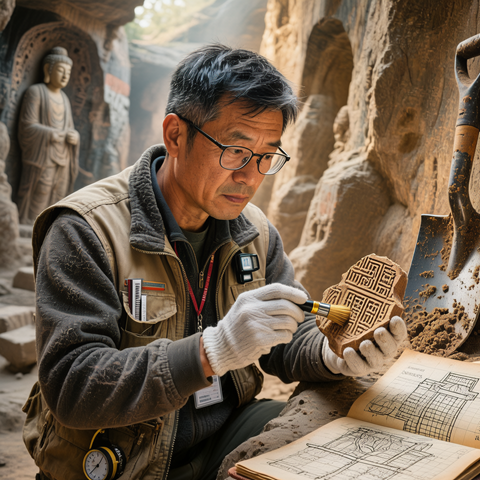
One must admire the precision of it all. A sum of ₹23.6 crore, a figure so pleasingly specific, so solidly bureaucratic, is transmuted into stone, mortar, and, presumably, a great many tastefully weathered signboards. The upgraded Poompuhar tourism complex in Tamil Nadu is now, we are told, ‘open’. The verb is instructive: a passive, administrative act, like unsealing a file or unlocking a treasury. The ancient port city of Poompuhar, sung into immortality by the Sangam poets, a place where merchants from Rome and Greece once haggled under a fierce sun, has been ‘opened’ after an investment. It is a transaction, neatly concluded. One can almost hear the soft click of a ledger closing.
The official narrative is one of impeccable, even noble, intent: heritage preservation hand-in-hand with coastal tourism growth. A virtuous circle, where the rupee of the modern traveller funds the guardianship of the past. It is a logic as smooth and globally franchised as the marble in a five-star lobby. From the souks of Marrakech, diligently ‘curated’ for Instagram, to the temples of Angkor Wat, their sublime decay now meticulously managed by ticket-issuing algorithms, the world is engaged in a vast, collective act of packaging. We are not so much preserving history as constructing a palatable, non-threatening facsimile of it—a heritage theme park where the only permissible chaos is the orderly shuffle of visitor feet.
The British, in their imperial twilight, were past masters of this melancholy craft. They would prop up a crumbling façade in some dusty outpost, not out of reverence, but to maintain the picturesque illusion of continuity, a backdrop against which their own, more orderly narrative could play out. There is a whiff of that same detached curation in Poompuhar’s upgrade. The complex promises to ‘boost’ tourism. But what, precisely, is being boosted? Is it a deeper, trembling connection with the ghost of the Chola dynasty, with the echoes of waves that once drowned a city in legend? Or is it the revenue from coach parks, souvenir stalls selling plastic replicas of terracotta figurines, and the sale of bottled water to parched tourists being shepherded from ‘interpretive centre’ to ‘sculpture garden’?
Consider the alternative, the un-managed relic. I think of the skeletal remains of the *SS Ayrfield
-
in Homebush Bay, Australia, a rusted hull erupting with a startling, defiant mangrove forest. Or the bombed-out Kaiser Wilhelm Memorial Church in Berlin, left as a jagged, poignant *memento mori
-
amidst the city’s gleaming prosperity. Their power lies in their unresolved state, in their stubborn refusal to be ‘upgraded’. They are collisions of time, not sanitised exhibits. They demand a participation from the observer that no audio guide can provide. One fears that the new Poompuhar, for all its crores, may have ironed out precisely that vital, unsettling wrinkle in time.
This is the modern anxiety, dissected with cool, ironic detachment: our desperate, well-funded attempt to commodify authenticity. We fly across continents, seeking the ‘real’, only to find it has been pre-emptively prepared for our consumption, its rough edges polished to a safe, reflective sheen. The global tourism industry, that great, insatiable engine, operates on a paradox: it must sell difference, while ensuring the experience is standardised enough not to frighten the customers. A heritage site, therefore, must be poignant, but not disturbing; educational, but not intellectually taxing; ancient, but equipped with clean toilets.
And so, beneath the sparkling wit of this analysis lies a vein of melancholic clarity. One observes the opening of the Poompuhar complex with a sense of being both part of this world and profoundly outside of it. One is the potential tourist, the beneficiary of the smooth pathways and informative plaques. Yet one is also the ghost at the feast, watching as the raw, poetic tragedy of a lost city—a story of human ambition humbled by the sea—is processed into a ‘tourism product’. The investment will doubtless be deemed a success when the visitor numbers tick upwards. The local economy may well flourish. This is the undeniable good.
But as the first air-conditioned coaches disgorge their cargo onto the reclaimed land, one wonders what the poets of Sangam would make of it. They wrote of the fury of the ocean, the fleeting glory of kings, the ache of lovers separated by fate. Their imagery was visceral, sudden, and profound. Would they see in this new complex a fitting tribute, or a final, gentle entombment of their fierce, ungovernable world? The sea, of course, remains nearby, indifferent to both crore and curation, its rhythm unchanged since it swallowed the original city. It is the one exhibit they could never upgrade, and the only one that truly tells the whole, uncomfortable story.