🏯 Xuanwu Rock Carving at Shenbi City
"Tortoise and Snake subdue the waters, Xuanwu guards the city" — A stone-carved testament to the spiritual faith of the Southern Song military and civilians
📍 Basic Information
- Name: Xuanwu Rock Carving at Shenbi City
- Location: On the eastern inner wall of the East Gate at the site of Shenbi City, beside Provincial Road 003 in Jiaotan Township (now part of Xianzhen Town), Hejiang County, Sichuan Province
- Heritage System: Integral component of the "Shenbi City Site," a nationally designated key cultural relic protection unit listed by the State Council in 2006
- Protection Level: National-level cultural heritage site (included within the overall conservation zone of the Shenbi City Site)
- Access Status: Free admission; an outdoor immovable cultural relic. Visitors are advised to schedule appointments with local cultural relics authorities or join guided tours led by professionals
⏳ Historical Development
Shenbi City was a pivotal stronghold in the Southern Song Dynasty’s mountain fortress defense system during its resistance against the Yuan invasion. Construction began in the third year of Chunyou (1243 AD), under the supervision of Yu Jie, the Military Commissioner of Sichuan, and it stood alongside Diaoyu City and Bai Di City as one of the “Eight Pillars of Central Sichuan.”
- Definitive Dating: The Xuanwu carving was carved during the Baoyou era of the Southern Song Dynasty (1253–1258 AD), precisely when Shenbi City served as the administrative center of Luzhou and the command hub for southern Sichuan’s anti-Yuan resistance.
- Historical Context: The Southern Song military and civilian population deeply revered the four celestial deities of Daoism, particularly Xuanwu (the True Martial Emperor), believed to control water and fire and guard the northern direction. With three sides bordered by tributaries of the Yangtze River—especially the Chishui River—Shenbi City was situated on treacherous terrain prone to frequent flooding. Amid prolonged sieges and warfare, the people carved the image of Xuanwu into the natural red sandstone cliff inside the East Gate, praying: “May tortoise and snake unite in form, quell the floods, and protect our isolated city.”
- Enduring Legacy: Despite enduring the upheavals of the Song-Yuan transition, Ming and Qing earthquakes, and human disturbances in the 20th century, the carving remains remarkably intact. It is the only surviving Song Dynasty rock carving at Shenbi City with clear chronological context and religious function.
🏛️ Architectural and Sculptural Features
🔹 The Sculpture Itself
- Form: High-relief cliff carving, measuring 2.18 meters in height, 1.75 meters in width, and 0.32 meters in depth
- Main Figure:
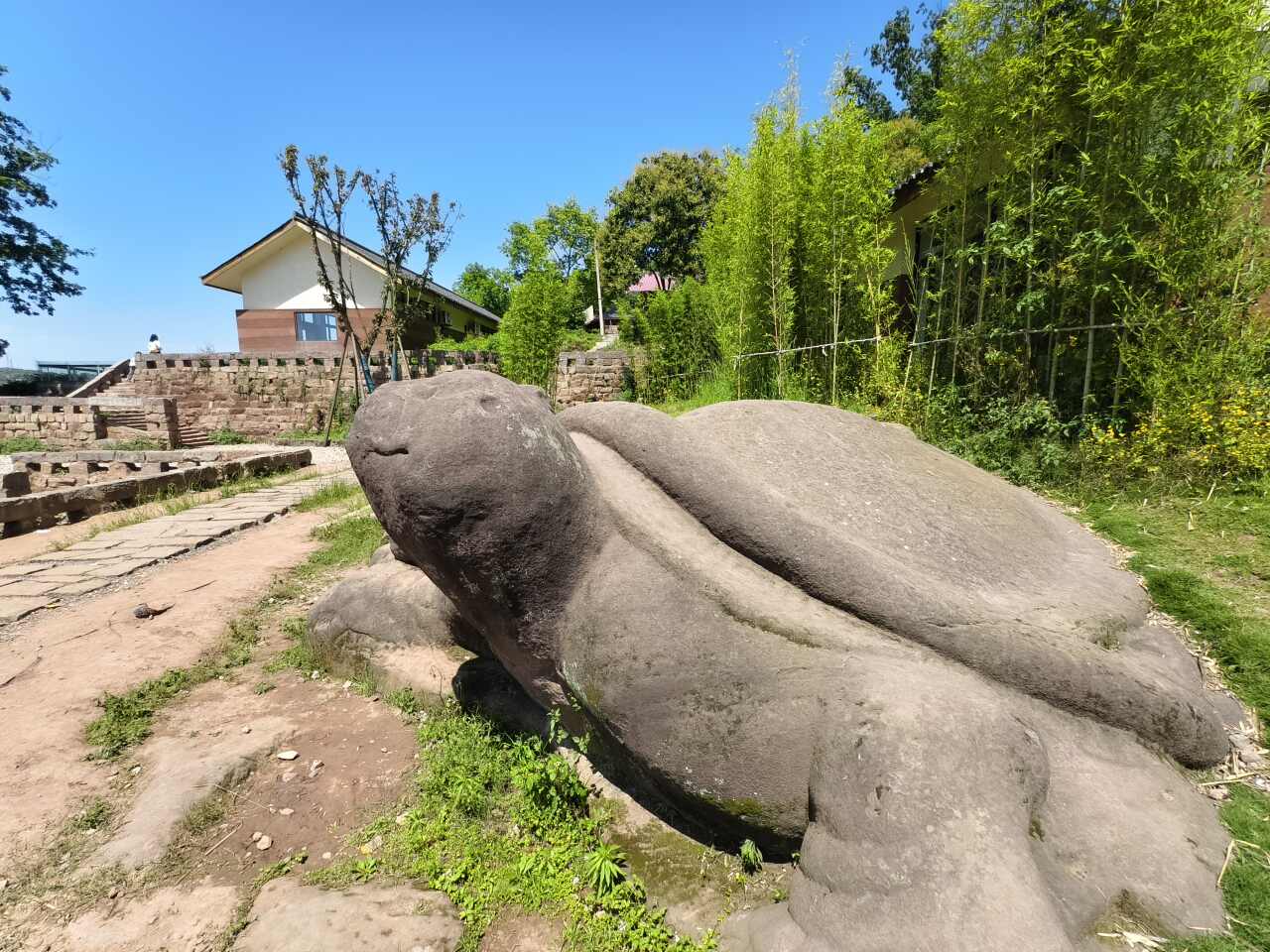
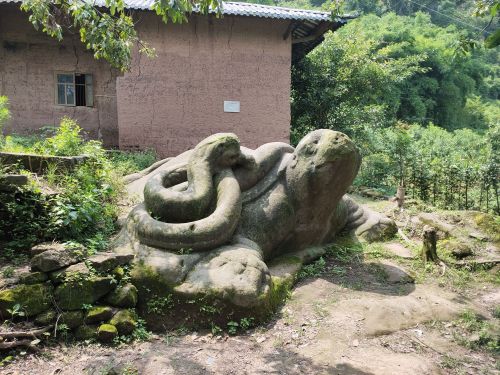
- Xuanwu’s Divine Form: Human head with serpent body, wearing a Daoist headdress, long beard extending to the chest, draped in a cross-collared Daoist robe. The left foot rests on a tortoise, the right on a snake, their bodies entwined in a circular embrace, heads and tails meeting in harmony.
- Iconographic Details: The serpent’s head rises proudly upward, while the tortoise’s head is slightly retracted—accurately reflecting the classical depiction described in Yunji Qiqian as “Xuanwu’s form unites tortoise and snake, the northern deity.” The garment folds employ the characteristic “Cao Yi Chushui” (Cao-style flowing water) technique of Southern Song negative-line carving, producing fluid and vigorous lines.
- Inscribed Record: Five lines of regular script incised on the cliff to the right of the sculpture read: “In the Year Wuwu of Baoyou / Guard Commander Zhao of Shenbi City / Dedicated to pray for national blessings / Carved this statue of the Holy Xuanwu / To eternally safeguard the frontier.” Though partially eroded, the phrase “Baoyou Wuwu” (i.e., 1258 AD) remains clearly legible, serving as the definitive dating evidence.
🔹 Surrounding Environment
- Located on the northeast-facing cliff inside the East Gate’s walled enclosure, backed by a sheer cliff face and facing the Chishui River valley—geographically aligning with Daoist tradition that associates Xuanwu with the north (Shenbi City itself faces south with its East Gate functioning as a northern defensive node);
- The cliff surface was artificially smoothed during the Song Dynasty; a shallow projecting eave above the carving serves both practical purposes—protection from rain erosion—and symbolic ones—evoking a celestial canopy;
- Nearby traces of contemporaneous Song-era horse trails, remnants of stone-throwing defenses, and a small Ming Dynasty inscription reading “Repaired in the Year Jiashen of Wanli” further confirm the site’s enduring veneration across centuries.
📜 Cultural Significance
| Dimension | Core Value Statement |
|---|
| Historical Value | ✅ One of the rare physical remnants of late Southern Song military faith in border cities nationwide, providing tangible proof of wartime governance through “religious ritual to strengthen morale and stabilize public sentiment”;<br>✅ Directly corroborates historical records in the History of the Song Dynasty: Biography of Yu Jie and Qi Dong Yeyu, which document that “all cities in Shu region worshipped Zhenwu.” |
| Artistic Value | ✅ The most complete and representative example of Southern Song Xuanwu carvings preserved in Sichuan, inheriting the iconographic standards of the Yingzao Fashi (Treatise on Architectural Methods) from the Northern Song, yet exhibiting the rugged, powerful style typical of southern Sichuan;<br>✅ The attire, posture, and dynamic interplay between tortoise and serpent conform precisely to Daoist theological iconography, offering a crucial reference point for studying Southern Song Daoist art. |
| Scientific Value | ✅ The rock composition (Jurassic red sandstone), weathering patterns, and stratigraphic relationship with inscriptions provide a benchmark for dating and environmental archaeology of Southern Sichuan’s rock carvings;<br>✅ Together with the rammed-earth walls of Shenbi City and the remains of ancient weapon workshops, it forms a three-dimensional empirical framework linking “faith—defense—production.” |
| Spiritual Value | ✅ A spiritual emblem of the Southern Song military and civilians’ unyielding resistance; the intertwined tortoise and snake symbolize resilience and symbiosis, reflecting the Chinese civilization’s philosophical core of “harmonizing strength with gentleness, upholding righteousness while embracing innovation”;<br>✅ An important historical carrier for strengthening the sense of community among China’s diverse ethnic groups in the modern era. |
🧭 Traveler’s Practical Information
🚗 Transportation Guide
- By Car: Navigate to “Shenbi City Site” (Jiaotan Community, Xianzhen Town, Hejiang County). After reaching the East Gate signpost along Provincial Road 003, walk approximately 300 meters down a stone staircase path to reach the site;
- Public Transit: Take a bus from Luzhou Passenger Transport Center to Xianzhen Town on the “Luzhou–Xianzhen” route, then transfer to a local motorcycle or hike about 12 kilometers (recommended to arrange private vehicle transport);
- Note: Provincial Road 003 is a narrow mountain road—exercise caution during rainy seasons. There is no parking area at the site; vehicles must be parked at designated zones near the entrance of Jiaotan Town.
🕒 Optimal Visiting Time
- Season: Spring and autumn (March–May, September–November), when the climate is pleasant and the carving’s contours remain clearly visible beneath lush vegetation;
- Time of Day: 9:00 AM – 11:30 AM (angled sunlight enhances visibility of relief layers); avoid midday direct sunlight, which may cause glare and distort visual details.
📸 Visitor Guidelines
- ✅ Respect the Heritage: No touching, climbing, or rubbing the carving; flash photography is strictly prohibited;
- ✅ Environmental Protection: Do not litter; avoid disturbing birds nesting on the cliff (common species include Red-billed Blue Magpies and Rock Doves);
- ✅ Safety Notice: The cliff surface is slippery—avoid entry after rain; no railings are installed around the area—please keep a safe distance from the edge;
- 📚 Recommended Combined Visit: Shenbi City Site Museum (Xianzhen Town), Old Lu Zhou Government Office Ruins, and Ancient Salt Trail Remains along the Yangtze River.
📞 Inquiry and Guided Tours
- Hejiang County Cultural Relics Protection Management Office: 0830–5212317 (working days)
- Guided Tour Booking for Shenbi City Site: Follow the WeChat official account “Hejiang Culture & Tourism” → “Reservation Services” section
- Academic Support: Institute of History and Culture, Sichuan University · Research Center for Song Dynasty and Grottoes (regularly publishes archaeological briefs on Shenbi City)
🌟 Conclusion
A silent guardian carved a thousand years ago, coiled upon the crimson cliff by the Chishui River—this is no mythic phantom, but the star that Southern Song soldiers once gazed upon while sharpening their swords, the talisman clutched by common folk during siege-ridden days, and an eternal inscription of resilience in the upper reaches of the Yangtze civilization. Stand still, gaze upon the intertwined tortoise and snake, and hear echoing from deep history the undying resonance of loyalty and courage.