🏯 Qingshiguan Ruins of the Qi Great Wall
"One man guards the pass, ten thousand cannot break through"—a relic of ancient Qi frontier fortifications, a strategic stronghold for over a millennium
📍 Location and Transportation Information
- Address: Qingshiguan Village, Chishang Town, Boshan District, Zibo City, Shandong Province, nestled in a mountain hollow just north of National Highway 205 (formerly G205)
- Geographic Coordinates: 36°25′48″ N, 118°04′12″ E
- Transportation Options:
- ✅ By Car: Approximately 1.5 hours (about 110 km) from Jinan; head south along G205 until you see the "Qingshiguan" sign, then turn right onto a winding mountain road—about 3 km brings you to the site;
- ✅ Public Transit: Take a rural bus from Zibo's Central Bus Station heading toward Boshan–Chishang; get off at the "Qingshiguan" stop and walk 500 meters to reach the core ruins;
- ⚠️ The gate area is a protected cultural heritage zone—large tour buses must park outside and visitors must enter on foot.
📜 Historical Evolution: A Majestic Spring and Autumn Fortress, the Northern Shield of Qi
Qingshiguan is one of the best-preserved and most representative surviving gate sites of the Qi Great Wall, originally constructed during the Spring and Autumn Period (mid-7th century BCE) and fully developed by the early Warring States Period (circa 440 BCE). It served as a key military node in the vast "Thousand-li Qi Great Wall," built by the State of Qi to defend against invasions from Lu, Chu, and other central states.
- 🔹 Strategic Significance: Guarding the vital passage through the central Shandong mountains—the ancient route connecting Zichuan, Boshan, and Laiwu—it was the only land route linking the capital Linzi of Qi to southern Shandong and northern Huai River regions, earning it the title of "the First Pass of Qi and Lu";
- 🔹 Historical Records: The Zuo Zhuan (Commentary of Zuo), in the 18th year of Duke Xiang, mentions “Duke Qi repelled them at Pingyin,” with Du Yu’s annotation stating: “Pingyin lies northeast of Lubu County in Ji Prefecture, possessing a defensive gate—Qingshiguan is its surviving structure.” The Qing Dynasty’s Comprehensive Gazetteer of Shandong clearly records: “Qingshiguan lies 100 li northeast of Laiwu County, flanked by two mountains with a single path running through—built by Qi to guard against Lu”;
- 🔹 Historical Events: In early Han times, the Five Hundred Followers of Tian Heng once resisted Han forces here. During the Jiajing reign of the Ming Dynasty, the gate tower was rebuilt. The Yanshen Town Gazetteer under Emperor Kangxi meticulously documents its construction: “The stone gate stands 18 chi high and 12 chi wide, with an enemy watchtower atop.”
🏗️ Architectural Remains: Masterpiece of Stone Craftsmanship, Ingenious Design
Qingshiguan is renowned for its use of local materials and adaptation to terrain, showcasing advanced construction techniques from the Spring and Autumn and Warring States periods, including rammed earth encased in stone and vaulted masonry:
- Main Fortress Structure:
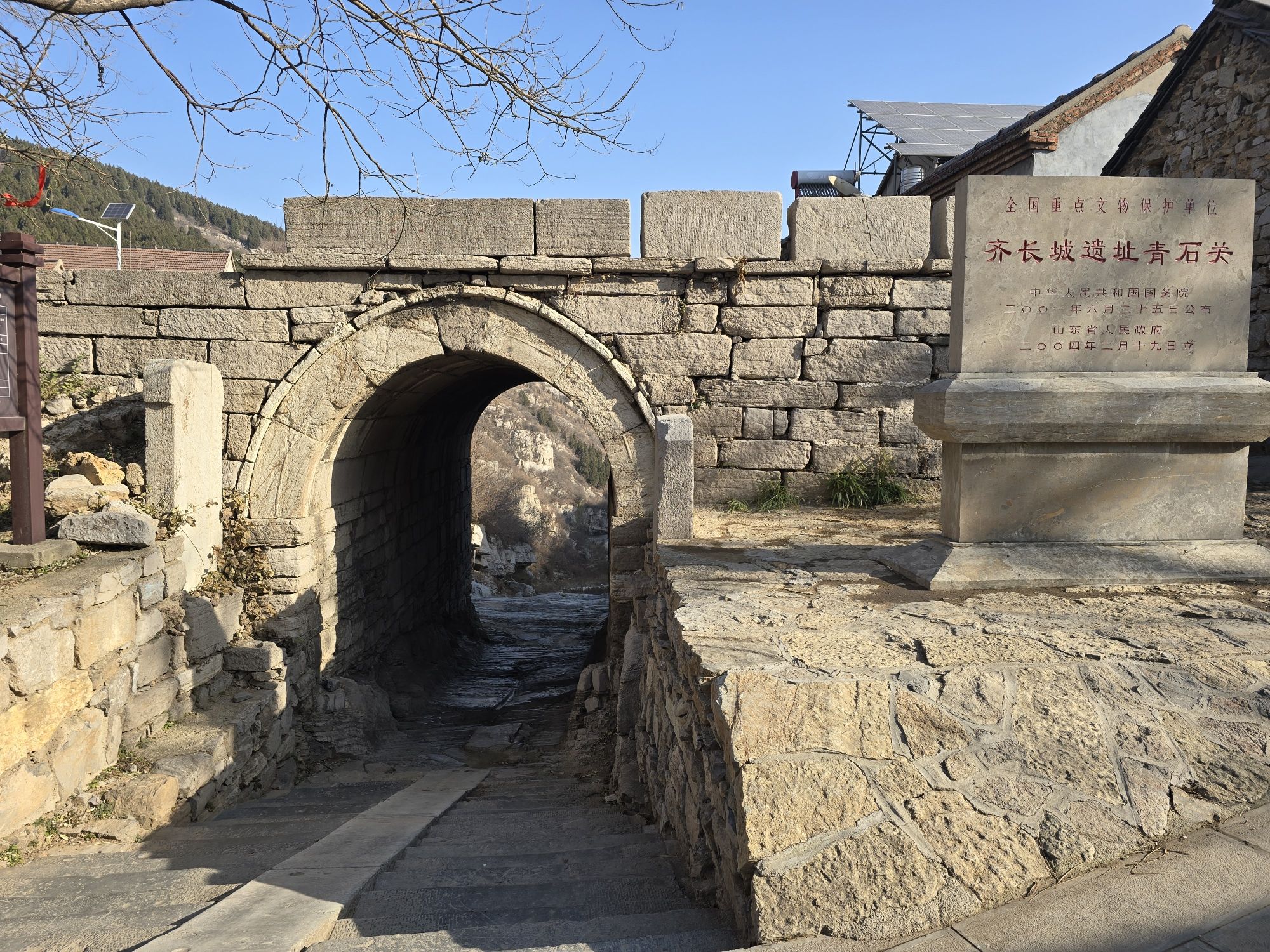
- ✅ Gate Arch Ruins: One surviving north-south oriented stone-vaulted gateway remains, standing 4.2 meters high, 3.3 meters wide, and 9.5 meters deep. The vaulted ceiling consists of seven layers of interlocking green stone laid in staggered courses without mortar, having endured over 2,500 years of weathering yet remaining remarkably stable;
- ✅ Rampart Fragments: Extending about 80 meters east and west, walls rise 2 to 4 meters high, with massive stones forming the base and rammed earth mixed with gravel above. Some sections still display typical Warring States-era "banzhu" ramming marks;
- Ancillary Facilities:
- ✅ Wencity Foundation: An arc-shaped rammed earth platform discovered south of the gate confirms the former presence of a wencity (a fortified outer enclosure); archaeological surveys have confirmed this, though full excavation has not yet occurred;
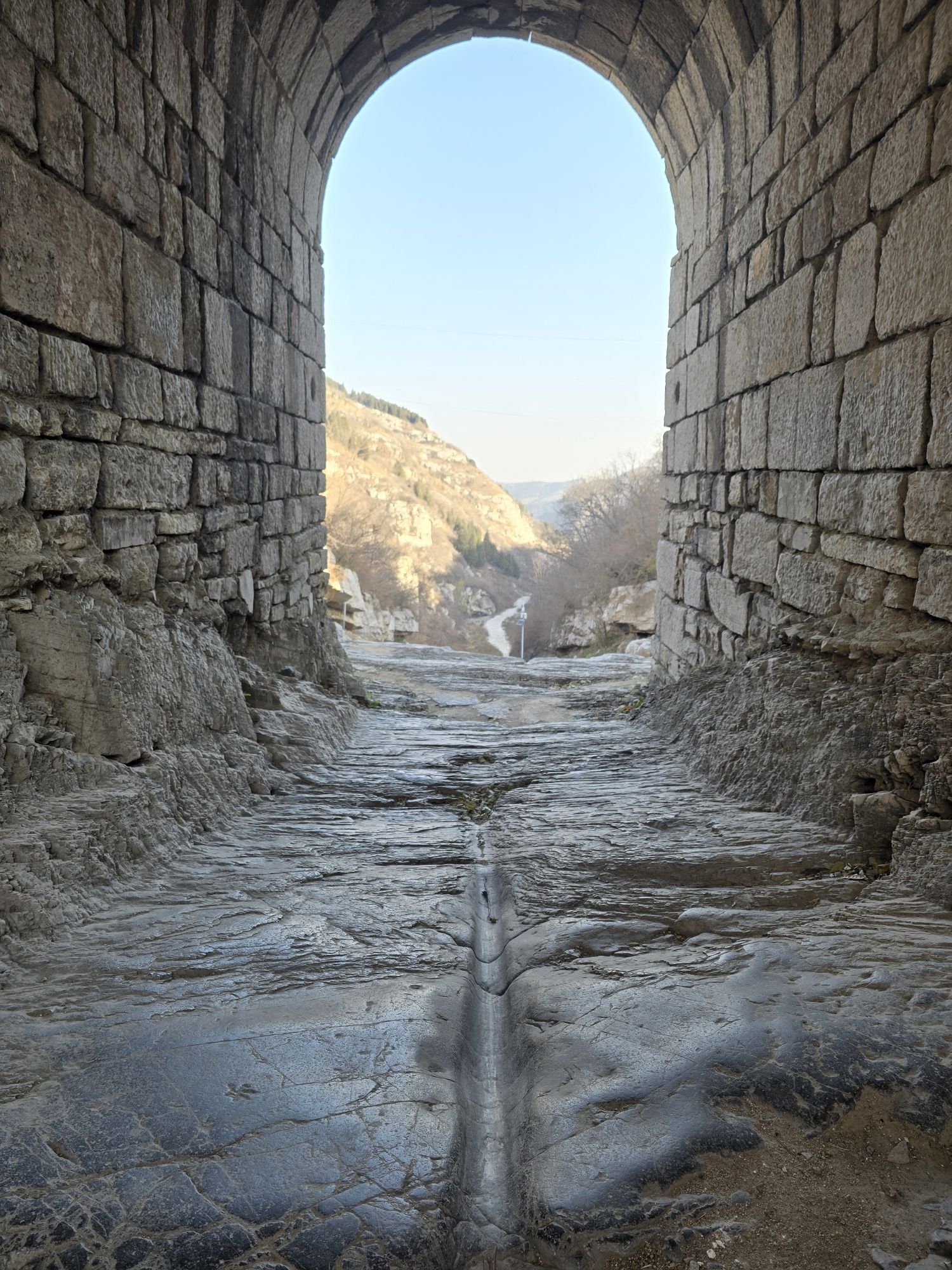
- ✅ Ancient Road Remains: Over 1.5 kilometers of original cart track pavement survive inside and outside the gate. The surface stone slabs bear parallel grooves up to 15–20 centimeters deep, worn by countless wheels across centuries—recognized as "the oldest extant road specimen in China";
- ✅ Stone Inscriptions and Artifacts: Three inscribed steles from the Ming and Qing dynasties remain within the site. Among them, the Qing Dynasty’s Record of the Rebuilding of Qingshiguan (from the 54th year of Qianlong) details the fortress’s structure and repair history. Additionally, a fragment of a Ming-era Qing Great Wall Boundary Stone of Qingshiguan is preserved at the Boshan District Cultural Relics Management Office.
🏺 Archaeological and Cultural Value
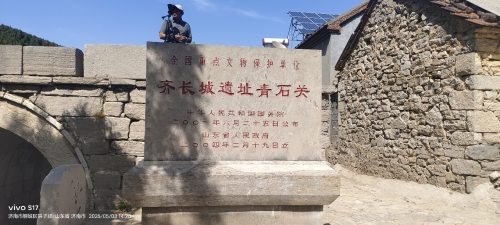
- 🌟 National Key Cultural Heritage Site: Listed in June 2001 as part of the "Ruins of the Qi Great Wall," designated by the State Council as the Fifth Batch of National Key Protected Sites (No. 5-0227-1-227);
- 🌟 Archaeological Significance: From 2013 to 2016, the Shandong Provincial Institute of Archaeology conducted systematic surveys and limited excavations, confirming Qingshiguan as one of the earliest constructed sections of the Qi Great Wall. Artifacts unearthed include late Spring and Autumn period pottery tripod feet and bean handles, as well as Warring States bronze arrowheads, substantiating its military function;
- 🌟 Benchmark in Ancient Construction Technology: Its dry-stone vault technique predates similar Qin-Han structures by over three centuries, offering an irreplaceable physical model for studying early Chinese stone bridge and fortress construction methods.
🌍 Cultural Significance and Symbolic Meaning
- 📜 One of the Origins of the "Meng Jiangnü Cries the Great Wall" Legend: Local chronicles and folk traditions identify Qingshiguan as the prototype for the story (though the Great Wall referenced is the Qi Great Wall, not the Qin Wall). The site contains the foundation stone of a Qing Dynasty temple dedicated to Meng Jiangnü, symbolizing the tale’s roots in Qi culture;
- 📜 Embodiment of Qi Culture’s Resolute Spirit: The site’s location in a treacherous, rugged landscape and its robust construction reflect the Qi people’s philosophy of militancy, practicality, and adaptation to nature, closely aligning with the principles in Guanzi: “Utilize natural resources, follow local advantages”;
- 📜 Literary and Poetic Landmark: Qing poet Zhao Zhixin wrote in his poem Passing Through Qingshiguan: “Mountains embrace the southwest, their stone angles all face north… Below lies a deep valley, above gusts of sorrowful wind.” Today, the “Qi Wind Poetry Wall” displays over twenty poems composed throughout history about the pass.
🧭 Visitor Guide
| Item | Description |
|---|
| Opening Hours | Open year-round |
| Key Attractions | Vaulted Gate Arch |
| Recommended Route | Viewpoint at G205 National Highway (panoramic view) → Stone Steps Pathway into the Gate → Passage through the Gateway → Westward along the Ancient Road to the "Wencity Foundation" Viewing Spot → Return via the "Qi Wind Poetry Wall" |
| Visitor Tips | • Do not climb or deface walls or inscriptions; • The ancient road may be slippery—wear non-slip footwear; • No commercial facilities available at the site—bring your own water; • Drone flights prohibited within the heritage zone (prior application required at Boshan District Culture and Tourism Bureau) |
🌐 Academic Research and Conservation Status
- 🛡️ Conservation Framework: Integrated into the Overall Protection Plan for the Qi Great Wall (2021–2035), adhering to the principles of "minimal intervention and original state preservation." A critical emergency reinforcement project on the gate structure was completed in 2022;
- 📚 Research Hub: Shandong University’s School of History and Culture has established a Qingshiguan Field Research Station, conducting ongoing studies on settlement archaeology and environmental change along the Great Wall corridor;
- 🌱 Cultural Revitalization: As part of the construction of the Qi Great Wall National Cultural Park (Shandong Section), Qingshiguan is currently planning the development of a Cultural Interpretation Center for the Qi Great Wall (expected to open in 2025), integrating digital reconstructions, immersive guided tours, and intangible cultural heritage performances.
🌄 Climb Qingshiguan, tread upon millennia-old wheel ruts, touch the weathered stone arch—what you feel is not merely stone, but the warmth of Qi soldiers guarding the border, the echoes of hammers shaping rock, and the indelible coordinates etched by Chinese civilization along the mountain ridgeline.