🏯 Qianfo Mountain Scenic Area · Temple of Shun
"Shun tilled the land beneath Lishan" —— Records of the Grand Historian: The Annals of the Five Emperors
Located within the core zone of Jinan’s Qianfo Mountain Scenic Area, the Temple of Shun stands as one of the oldest and most historically significant memorial shrines dedicated to an ancient sage king in Jinan. With over four thousand years of cultural heritage and a profound embodiment of Confucian ideals of moral governance, it serves as a living testament to the enduring legacy of "Shun Culture."
📜 Historical Evolution: Rooted in Antiquity, Flourished Through the Ages
- Origins trace back to pre-Qin times: According to historical texts such as Commentary on the Waterways and Qicheng, Lishan (today’s Qianfo Mountain) has long been recognized as the site where Shun once farmed. By the Han Dynasty, a temple was already established here in his honor—representing early regional veneration of Shun’s sacred footprint.
- Established during the Tang Dynasty: In the reign of Emperor Taizong (627–649), local officials constructed a “Temple of Shun” at the northern foot of Qianfo Mountain, laying the foundation for formal worship. During the Jin and Yuan dynasties, its spiritual significance grew steadily, becoming a pivotal center of Shun culture in the Qilu region.
- Formalized in the Ming Dynasty: In the fourth year of Chenghua (1468), Shandong Provincial Governor Li Yu oversaw a major renovation, officially naming the site “Temple of Shun” and integrating it into the Lishan Courtyard complex. This marked the establishment of a ritual layout characterized by “front hall, rear quarters, symmetrical axial planning,” in accordance with Ming dynasty regulations.
- Continued maintenance through the Qing Dynasty: The imperial court allocated funds for repairs during both the Kangxi and Qianlong eras. Emperor Qianlong, during his southern tour, personally inscribed the plaque “Virtue Matches Heaven and Earth” (the original is lost; the current version is a 1990s replica based on Qing palace records).
- Modern preservation and revival: Designated a key cultural relic protection unit in Jinan during the 1980s, the temple was elevated alongside Qianfo Mountain as a National Scenic Area in 2006. A comprehensive restoration and environmental improvement project was completed in 2019, fully reinstating its traditional sacrificial functions.
🏛️ Architectural Layout: Adhering to Ancient Ritual, Simple and Reverent
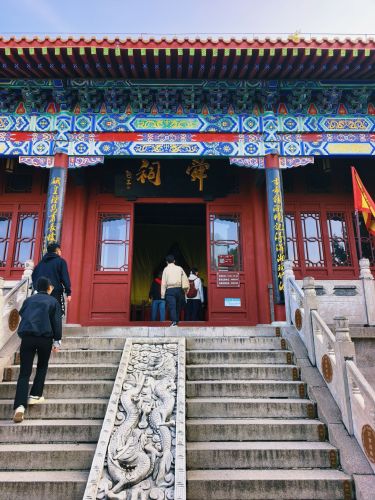
The Temple of Shun exemplifies typical Ming-era northern Chinese official temple architecture, facing south with a total area of approximately 1,200 square meters. Comprising a mountain gate, ceremonial gate, main hall, inner sanctuary, and east-west side halls, the entire complex strictly follows the ritual standards outlined in the Great Ming Code for ancestral temples:
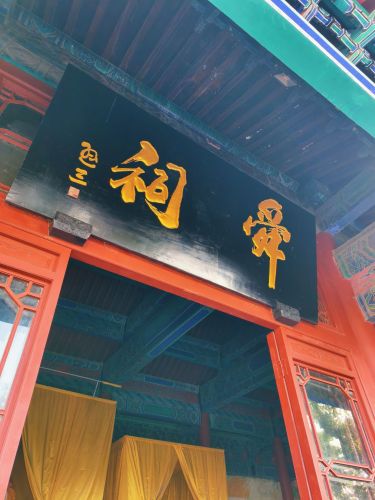
- Mountain Gate: A hip-roof structure with gray tiles and a hard roof, the gate bears a black plaque inscribed in gold with “Temple of Shun” (recreated in 1992 following Ming dynasty design). Flanking the gate are two Qing dynasty stone couplets:
“Lishan stands majestic, revered through millennia; Leize flows vast, echoing through endless ages.”
- Ceremonial Gate: Three bays with a single-eave hard roof. Its interior walls house the stele Record of the Restoration of the Temple of Shun from the fourth year of Chenghua (1468), a national third-class cultural relic. The inscription details the temple’s founding origins and lists donors who contributed to its reconstruction.
- Main Hall (Chongde Hall): Five bays wide, three bays deep, featuring a raised beam timber frame and triple-tiered bracket sets under the eaves. Inside, a seated statue of Emperor Shun (2.8 meters tall, carved from camphor wood and gilded, reconstructed in 1995 using Song Dynasty Yingzao Fashi techniques) is enshrined. Above the altar hangs the horizontal plaque “Filial Piety Moved Heaven,” imitating the handwriting of Emperor Qianlong.
- Inner Sanctuary: Located behind the main hall, this single-eave hard-roof structure houses statues of Emperor Shun and his two consorts, Ehuang and Nüying. The Ming dynasty painted clay sculptures, carefully restored through scientific conservation, are displayed in the eastern shrine—a rare surviving artifact of great antiquity.
- East and West Side Halls: The eastern hall honors virtuous ministers who served Shun, including Yu and Gaoyao. The western hall hosts the “Exhibition Room of Shun Culture,” showcasing historical stele rubbings, facsimiles of local gazetteers, and replicas of Dawenkou culture pottery unearthed from the Chengziya archaeological site near Jinan.
🏺 Cultural Relics: Substantial Evidence, Invaluable Heritage
| Artifact Name | Period | Classification/Value | Notes |
|---|
| Stele: Record of the Restoration of the Temple of Shun (1468) | Ming Dynasty, 1468 | National Third-Class Cultural Relic | 728 characters in regular script, engraved in relief; the earliest extant original document concerning the Temple of Shun in Jinan |
| Qing Dynasty Incense Burner | Qing Dynasty, Qianlong era | Jinan Municipal Immovable Cultural Relic | Bronze, double handles, three legs; inscribed with “Presented by Lishan Academy” |
| Ancient Cypress Tree at the Temple of Shun | Over 480 years old | Shandong Province Famous Ancient Tree (No. JN0103) | Located before the ceremonial gate; traditionally planted during the Ming restoration, its gnarled branches form a dense canopy like clouds |
| Stone Railing Fragments from “Shun Well” | Song Dynasty (excavated during 1997 renovation of Lishan Courtyard) | Significant Archaeological Discovery | Inscribed with “Third Year of Xining in the Great Song Dynasty,” confirming the existence of a complete Shun-related landscape system by the Song period |
🌟 Cultural Significance: Virtue Nourishes the City, Ritual Transmits Civilization
- Geographical Anchor of Confucian Moral Governance: Shun’s life built upon virtues of filial piety, fraternal respect, benevolence, and humility. His legendary deeds—tilling fields on Lishan, fishing at Leze, crafting pottery by the river—are repeatedly cited in Mencius and Records of the Grand Historian. As one of the few ancient sage kings’ temples in China with uninterrupted worship, the Temple of Shun embodies the sacred spatial expression of the Confucian ideal: “Moral virtue matches heaven and earth.”
- Spiritual Origin of Jinan’s Urban Identity: “Shun Culture” profoundly shaped Jinan’s regional character—honesty, loyalty, and reverence for ritual. Although the name “Jinan” dates back to the Han Dynasty, the title “City of Shun” appears in the Commentary on the Waterways from the Northern Wei period. Qianfo Mountain was formerly known as “Shun Mountain,” making the Temple of Shun the foundational symbol of Jinan’s cultural identity.
- Living Carrier of Intangible Heritage: Each year on the third day of the third lunar month (the Shangsi Festival), the “Qianfo Mountain Shun Cultural Festival” is held, reviving the Ming Dynasty spring sacrifice rituals. Activities include musical and dance offerings, students reciting The Classic of Shun, and performances of intangible cultural heritage paper-cutting depicting the “Shun Plowing Scene.” In 2021, this festival was listed in the Shandong Provincial List of Representative Projects of Intangible Cultural Heritage.
🚶♂️ Visitor Information: Explore the Past, Seek Wisdom in Stillness
- 📍 Location: Within Lishan Courtyard, Qianfo Mountain Scenic Area, Lixia District, Jinan City, Shandong Province (just west of the north entrance to Qianfo Mountain, follow the “Tracing Lishan” guided path for about 300 meters)
- 🎫 Admission: Included in the general ticket for Qianfo Mountain Scenic Area (Peak Season ¥30, Off-Season ¥15; free for visitors aged 60+ and children under 1.4 meters)
- ⏰ Opening Hours: Daily 06:00–18:00 (extended to 17:30 in winter); interior visit to the main hall is limited to 200 people per day (bookable via the official WeChat account “Jinan Qianfo Mountain Scenic Area”)
- 🚌 Transportation Guide:
- Metro: Exit B of Line 4 at “Qianfo Mountain Station,” walk approx. 800 meters
- Bus: Take K56, K100, or K115 to “Qianfo Mountain Station,” then proceed west along Jingshi Road
- 📌 Helpful Tips:
- The Temple of Shun is a solemn ritual space—please remain quiet and avoid flash photography near deities;
- The courtyard features natural stone pathways—wear non-slip soft-soled shoes;
- QR codes for audio guides are available throughout the site, offering professional commentary (including ancient pronunciation readings of selected passages from The Book of Documents: The Classic of Shun).
Climbing the Thousand Buddha Peak, gazing upon Lishan; this temple stands here, carrying the eternal wind of virtue.
The Temple of Shun is more than brick and wood—it is an enduring moral beacon in the hearts of Jinan’s people. Standing before its steps, one still hears the distant echo of plow songs and feels the timeless surge of Leze’s waves.