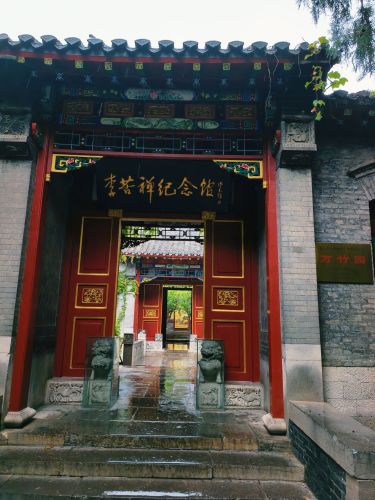
Baotu Spring · Li Kuchan Memorial Hall

Address
趵突泉南路1号趵突泉公园(趵突泉西侧)万竹园内
Description
🌊 Baotu Spring · Li Kuchan Memorial Hall
"The spring surges upward, water gushing like a wheel"—at the site where Baotu Spring soars, brush and ink convey the soul of Li Kuchan
📍 Basic Information
- Full Name: Baotu Spring Park · Li Kuchan Memorial Hall (Wanzhuyuan Branch)
- Address: No. 1 South Baotu Spring Road, Lixia District, Jinan City, Shandong Province, within Baotu Spring Park’s western Wanzhuyuan architectural complex
- Opening Hours:
- Daily 8:00–17:00 (last entry at 16:30)
- Closed on Mondays (except public holidays)
- Admission Policy:
- ✅ Free admission (requires valid ID for reservation)
- 🎫 Separate purchase required for Baotu Spring Park entrance ticket (40 RMB/person in peak season, 30 RMB/person in off-season); the memorial hall is a free facility within the park
🏯 Historical Evolution: A Century-Old Garden · The Final Home of a Master
-
Origins of Wanzhuyuan:
- Originally constructed during the Jin Dynasty, initially named "Wanzhuyuan" for its reputation of having ten thousand bamboo stalks planted along the embankment;
- Continuously renovated through the Ming and Qing dynasties; in the late Qing period, it was acquired by Zhang Huai Zhi, then Director of Salt Administration in Shandong, who expanded it into a typical official-style private garden blending southern Chinese garden aesthetics with northern courtyard architecture—its current layout largely established between 1917 and 1925 during reconstruction;
- Nationalized in 1951, became a branch of the Shandong Provincial Museum in 1956, and officially designated as the Li Kuchan Memorial Hall in 1986—recognized as China’s first government-approved individual art-themed museum.
-
Li Kuchan’s Connection to Jinan:
- Li Kuchan (1899–1983), native of Gaotang County, Shandong, was a founding figure of modern freehand flower-and-bird painting and a pioneering art educator;
- Upon his passing in 1983, his family honored his final wish by donating over 300 original artworks, manuscripts, letters, seals, and personal belongings to the state;
- Officially opened in December 1986 at Wanzhuyuan, with the name inscribed by Wang Meng, then Minister of Culture, establishing it as a vital cultural landmark in Jinan’s “City of Springs,” harmoniously combining natural elegance with profound humanistic heritage.
🏮 Architectural Features: Three Courtyards · Synthesis of Northern and Southern Elegance
Wanzhuyuan is a Ming Dynasty-style quadrangle compound covering approximately 5,000 square meters, comprising eastern, western, and southern courtyards plus a garden, renowned for its line: "How deep are these courtyards? Bamboo shadows sweep dust from the steps."
-
Overall Layout:
- ✅ Three-tiered siheyuan structure: Central axis runs through the south gate, corridor hall, and main residence, with symmetrical side courtyards on both east and west sides;
- ✅ Brick-and-wood construction with gray tile hip roofs: Beam and rafter decorations feature Su-style polychrome paintings; doors and windows display traditional motifs such as the "Three Friends in Cold Weather" and "Plum, Orchid, Bamboo, Chrysanthemum";
- ✅ Masterful water management and rockwork: Two spring pools within the garden draw upon underground springs from Baotu Spring; surrounding Taihu stones stand ruggedly, complementing lush bamboo groves in striking harmony;
- ✅ Bamboo culture woven throughout: Over 20 bamboo varieties, including purple bamboo, spotted bamboo, and gold-inlaid jade bamboo, total more than a thousand culms, substantiating the ancient name “Ten Thousand Bamboo.”
-
Exhibition Spaces of the Memorial Hall:
- Main exhibition halls located in the central western courtyard’s main hall and side wings, arranged thematically under four sections: "Artistic Quest," "Brush and Ink Soul," "Teaching Legacy," and "Patriotic Heart";
- A specially reconstructed late-life studio of Li Kuchan: Featuring a nanmu desk, blue-and-white porcelain inkstone, handwoven rattan brush holder, and an original hanging scroll inscribed with his own words: "All under Heaven for the Public Good."
🖼️ Core Artifacts and Artistic Treasures
The collection centers on authentic works by Li Kuchan, combining scholarly value with artistic excellence:
-
Representative Paintings and Calligraphy (rotating exhibitions, key highlights):
- 🌟 Prosperous Lotus (1978): A monumental ink wash lotus piece, powerful in brushwork, hailed as the "pinnacle achievement of freehand flower-and-bird painting in New China";
- 🌟 Elegant and Vigorous Spirit (1962): Signature work featuring hawks, rendered using seal script techniques for beaks and claws, evoking majestic presence;
- 🌟 Pine and Hawk Scroll (1957, manuscript long scroll): Contains 12 sketch drafts and inscriptions, documenting his practice of "integrating calligraphy into painting, guiding form through spirit."
-
Documents and Personal Manuscripts:
- ✍️ 187 original letters (1946–1983), including correspondence with masters such as Qi Baishi, Xu Beihong, and Pan Tianshou;
- ✍️ Hand-copied annotated version of Shitao’s Painting Discourses (1950s), marked in red and black ink, reflecting deep theoretical insight;
- 🪙 Three frequently used seals: "Kuchan," "Chanfu," and "Da Long," carved from tianhuang and shoushan stone, each with self-inscribed borders.
🌟 Cultural Significance and Academic Standing
-
Art Historical Importance:
- Systematically preserves Li Kuchan’s complete life journey—from enlightenment during the May Fourth Movement era, studies at the Beijing Academy of Arts, clandestine teaching during the War of Resistance, to shaping the new China’s art education system;
- Provides crucial evidence for his artistic philosophy: "fusing Eastern and Western traditions without losing intrinsic bone structure, inheriting antiquity while innovating with noble character"—a pivotal case study in the modern transformation of Chinese painting in the 20th century.
-
Educational and Outreach Functions:
- Hosts the "Li Kuchan Lecture Hall" (monthly sessions), inviting scholars from the Central Academy of Fine Arts and China Academy of Art;
- Offers the "Bamboo Shadows and Ink Traces" youth art education program, integrating on-site sketching, rubbings, and seal carving workshops within the Wanzhuyuan setting;
- Completed digitization project for 92% of first-class cultural relics, with high-resolution images available via the official website’s online gallery.
🚶♂️ Visitor Guide
-
Recommended Route (approximately 90 minutes for in-depth exploration):
graph LR A[Main Scenic Area of Baotu Spring] --> B[Walk westward across the "Guanlan Pavilion" corridor bridge] B --> C[Wanzhuyuan South Gate · Stone Inscription "Wanzhuyuan" on the Screen Wall] C --> D[Western Courtyard: Memorial Hall Main Exhibition Hall → Studio Reconstruction → Bamboo Shadow Stele Corridor] D --> E[Central Courtyard: Siheyuan Complex → Spring Pools → Bamboo Grove Pathway] E --> F[Eastern Courtyard: Li Kuchan’s Life Exhibition → Special Display Zone of Donated Artifacts] -
Visitor Tips:
- 📸 Flash photography and tripods are prohibited inside; photography restricted in certain special exhibition areas;
- 📚 Free copies of the bilingual (Chinese-English) guidebook Introduction to Li Kuchan’s Art available at the entrance;
- 🧭 On-site smart audio guide system (scan QR code via WeChat), featuring AR technology that reconstructs scenes of Li Kuchan painting;
- ☕ Nearby "Zhuying Teahouse" serves Baotu Spring Bi Luo Chun tea, brewed with spring water—present your day’s reservation code for 20% discount.
A single spring nourishes a thousand years, half a couch bears the weight of heaven and earth
—This place is not merely a view of springs, but a living sanctuary where one can touch the spirit of Chinese literati and experience the essence of freehand expressive art.