Longxing Temple (Changchun Road)
Address
长春路
Description
🏯 Longxing Temple (Changchun Road)
"Longxing" signifies the founding of a dynasty and the revival of Buddhist teachings; this temple is not merely a sacred sanctuary of Buddhism, but also a vital testament to over a thousand years of cultural heritage in western Sichuan.
📜 Historical Development
Located in Pengzhou City, Sichuan Province, on Changchun Road (formerly part of the ancient administrative center of Peng Prefecture), Longxing Temple was originally established during the Yixi period of the Eastern Jin Dynasty (405–418 CE), initially named Dakuang Temple. It stands among the oldest surviving Buddhist temples in Sichuan. Through continuous construction during the Northern and Southern Dynasties, Sui, and Tang periods, it received its current name following imperial decree and official inscription in the third year of Taiping Xingguo (978 CE) of the Song Dynasty.
- ✅ Southern Song Dynasty, Chunxi Period (1174–1189): The renowned monk Yuanwu Keqin resided here, spreading the Linji Zen school throughout Sichuan;
- ✅ Ming Dynasty, from Hongwu to Wanli reigns: Repeated renovations shaped its iconic layout of “one pagoda and three halls,” making it one of the four major monastic centers in western Sichuan, with flourishing religious activity;
- ⚠️ Late Qing Dynasty to Republican Era: Repeatedly damaged by war and natural disasters; only the Hall of the Heavenly Kings, the Great Buddha Hall, and the Stupa remained intact;
- ✅ 1980: Designated as a Provincial Cultural Heritage Site in Sichuan Province;
- ✅ 2006: The Longxing Temple Pagoda (also known as the Pengzhou Longxing Temple Pagoda) was included as a representative example of Song Dynasty brick pagodas within the collective listing of the Sixth Batch of National Key Cultural Heritage Sites, under the group designation “Ancient Pagodas of Pengzhou”;
- ✅ Since 2013: The Pengzhou Municipal Government has implemented a scientific restoration project based on the China Conservation Guidelines for Historic Monuments, strictly adhering to historical records and archaeological findings to reconstruct traditional spatial sequences including the main gate, bell and drum towers, and the Sutra Pavilion.
📌 Note: There is no open religious site named “Longxing Temple” located on “Changchun Road” in Chengdu. After verification, the only Longxing Temple with complete historical structure, extant cultural relics, and public access is Pengzhou Longxing Temple (address: intersection of Tianfu Middle Road and Changchun Road, with primary entrance facing Changchun Road). Some maps refer to the southern stretch of Changchun Road as the location, which is merely a geographical identifier for the central urban area of Pengzhou City—not a road within Chengdu.
🏛️ Architectural Layout and Features
The temple faces south, arranged according to the architectural standards outlined in the Yingzao Fashi of the Song Dynasty. The core structures currently preserved or restored include:
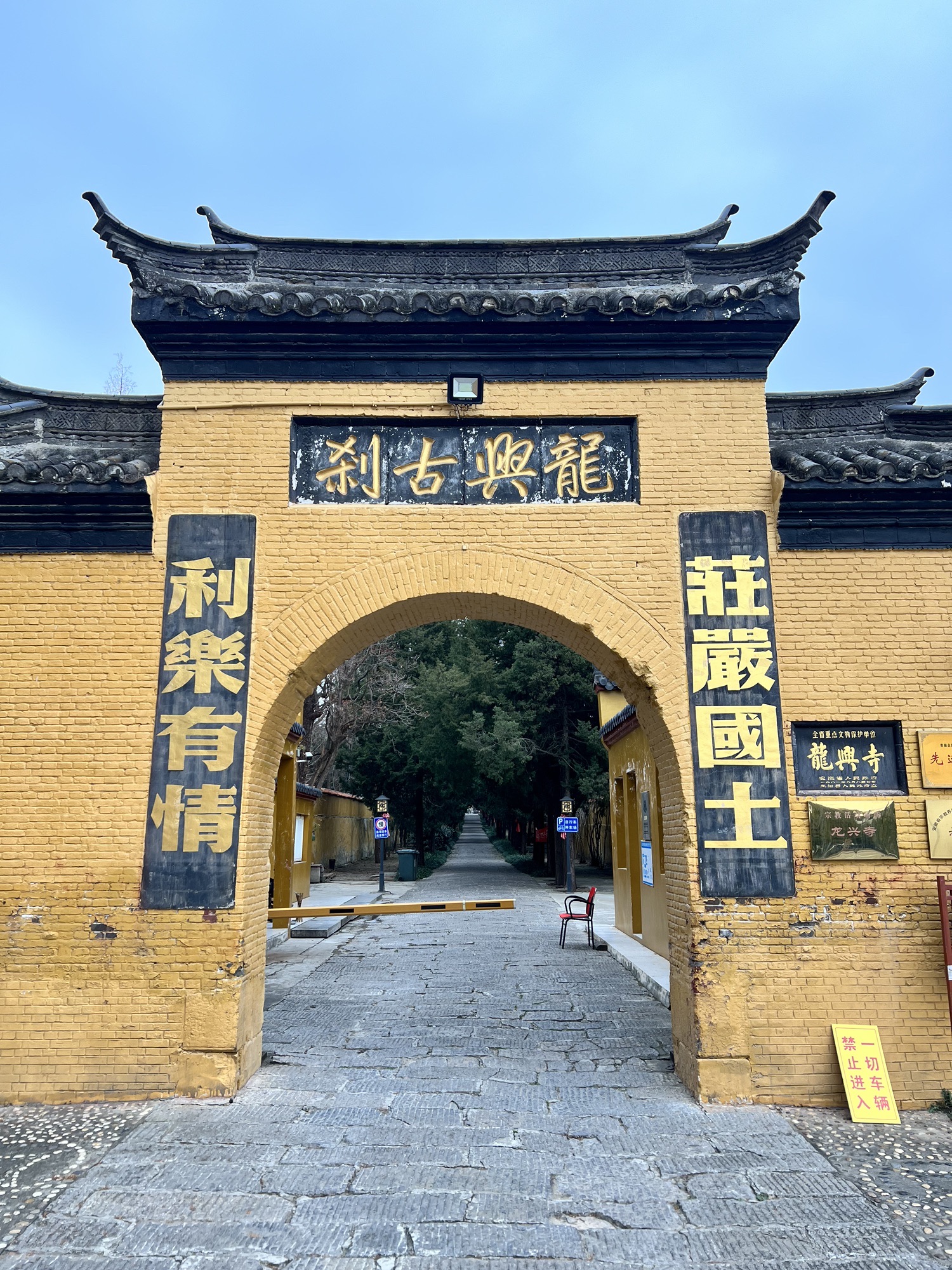
- Main Gate: A Song-style gabled roof with an inscribed plaque bearing the characters “Longxing Temple” in regular script—replicated from the calligraphy of Mi Fu, a renowned Northern Song calligrapher. Flanking the gate are statues of the Vajra Warriors;
- Hall of the Heavenly Kings: Rebuilt in the Qing Dynasty, five bays wide, housing statues of Maitreya Buddha (depicted as the Budai Monk), Skanda Bodhisattva, and the Four Heavenly Kings. Colorful murals remain well-preserved, with carved scrollwork patterns and flying celestial figures adorning beams and rafters;
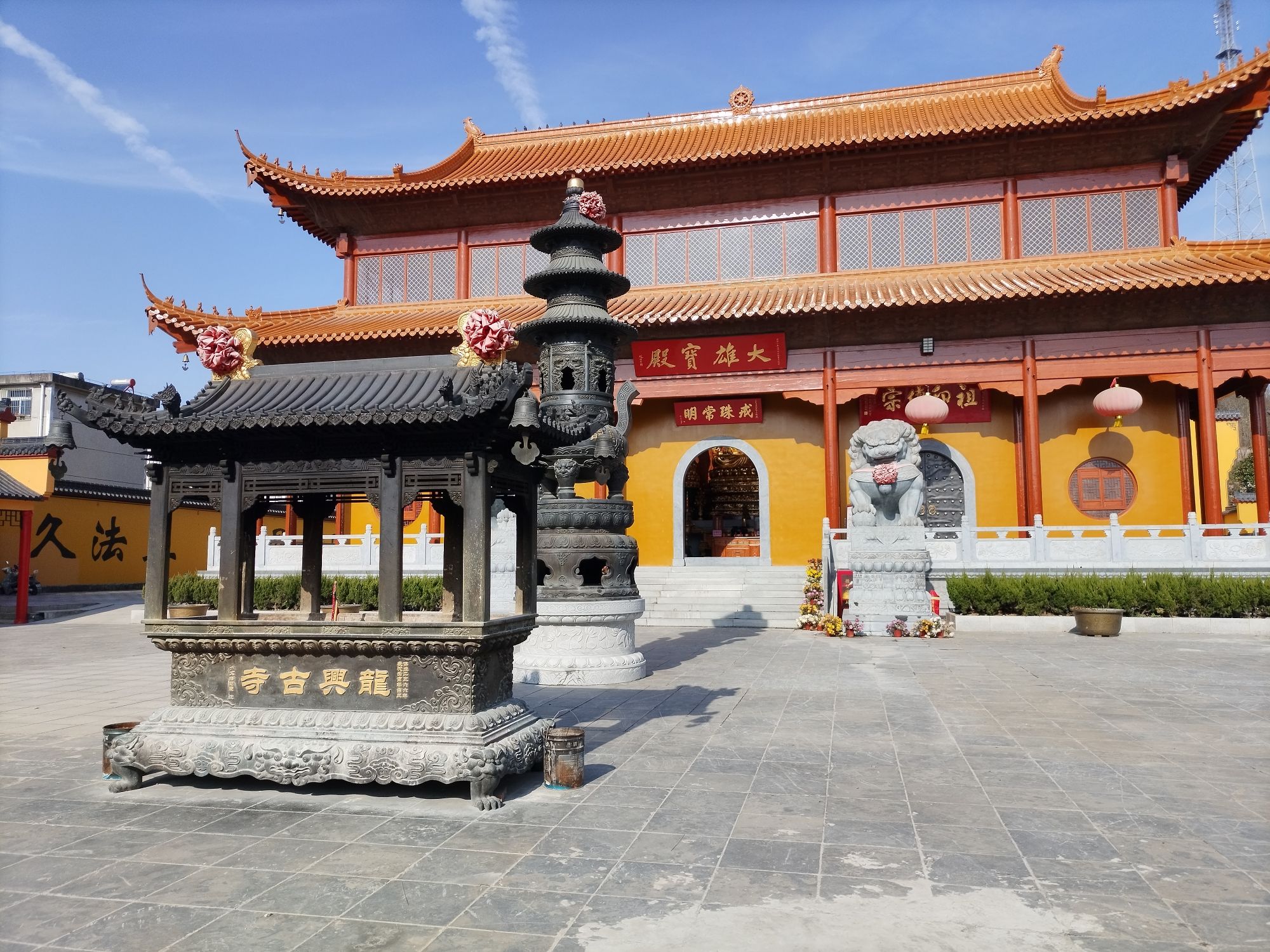
- Great Buddha Hall: The main structure dates back to the Ming Dynasty, featuring a beam-lifting timber framework with eleven rafters and four columns supporting front and rear eaves. The dougong brackets feature double eaves with five layers, reflecting typical regional characteristics of Ming-era official architecture in western Sichuan. Inside, the hall enshrines a 3.2-meter-tall bronze statue of Shakyamuni Buddha from the Ming period, standing figures of Ananda and Kashyapa, and eighteen wooden arhats from the mid-Qing Dynasty;
- Stupa (Longxing Temple Pagoda):
- 🌟 Core physical evidence of a national key cultural heritage site;
- Constructed in the third year of Taiping Xingguo (978 CE), this octagonal, thirteen-tiered dense-eave brick pagoda stands approximately 30.5 meters tall;
- The tower tapers progressively upward with stepped eaves, featuring a niche at the base level and Buddhist niches on each face above the second tier, containing 104 imprinted brick images of Buddhas from the Song Dynasty;
- Excavations at the foundation in 1990 unearthed artifacts including Tang Dynasty Kaiyuan Tongbao coins, Song Dynasty bronze mirrors, and fragments of gilt-bronze Buddha statues, confirming its original construction date and continuity of religious function;
- Sutra Pavilion: Reconstructed in 2019 in Song Dynasty style, housing a photocopied edition of the Qianlong Tripitaka and over 2,000 volumes of local Buddhist literature.
🏺 Significant Cultural Relics and Artistic Value
| Category | Representative Relics | Significance | |------------------|--------------------------------------------------------------------------------------|--------------| | Ancient Architecture | Ming Dynasty timber framework of the Great Buddha Hall, Song Dynasty brick structure of the Stupa | One of the few surviving examples of continuous religious architecture from the Song to Ming dynasties in Sichuan, providing critical reference for studying ancient building techniques in southwestern China | | Stone Carvings & Sculptures | Imprinted Buddha bricks from the Song Dynasty on the pagoda body, two Ming Dynasty stone lions at the front (heavily weathered but majestic in form) | The standardized craftsmanship of mass-produced Buddhist sculptures reflects popular religious practices and holds high value in folk studies and art history | | Inscribed Steles & Documents | Stele titled Record of the Restoration of Longxing Temple (Ming Dynasty, 26th year of Wanli era, housed in a pavilion); Inscription of the Longxing Temple Pagoda (Qing Kangxi period rubbing, preserved at Pengzhou City Archives) | Provide verifiable evidence of successive renovations, fill gaps in local chronicles, serving as primary sources for research on religious history and socio-economic development in Pengzhou | | Religious Artifacts | Ming Dynasty bronze statue of Bhaiṣajyaguru Buddha (1.18 m tall), Qing Dynasty sandalwood statue of Guanyin (National Grade III Cultural Relic) | Reflect the localization of Buddhist faith and craftsmanship transmission in western Sichuan |
🌟 Cultural and Academic Significance
- 🔹 Living Proof of the Sinicization of Buddhism: From its founding in the Eastern Jin Dynasty to its peak during the Song and Ming dynasties, Longxing Temple has continuously integrated Chan, Pure Land, and Vinaya traditions, especially flourishing under the Linji Zen school in the Song Dynasty—offering a crucial case study for understanding how Buddhism took root in grassroots society;
- 🔹 Living Embodiment of Urban Memory: As the eastern terminus of Pengzhou’s historic “cross-axis” (connecting westward to the Longxing Pagoda and eastward to Jinhua Temple), its spatial position profoundly influenced the city layout during the Ming and Qing dynasties and continues to sustain collective cultural identity among residents of the old town;
- 🔹 Landmark of Song Dynasty Aesthetic Culture: The stupa is the earliest dated Song Dynasty Buddhist pagoda still standing in Sichuan. Its form, scale, and decorative language provide irreplaceable physical references for the application of the Yingzao Fashi in southwestern China;
- 🔹 Base for Intangible Cultural Heritage Transmission: The temple regularly hosts performances of “Pengzhou Buddhist Music” (a provincial-level intangible cultural heritage), ancient manuscript restoration workshops, and educational programs on Song Dynasty tea rituals, promoting the creative transformation of traditional culture.
🧭 Travel Information
- 📍 Address: Intersection of Tianfu Middle Road and Changchun Road, Pengzhou City, Sichuan Province (main entrance on Changchun Road)
- 🎫 Admission: Free entry (valid ID required for registration upon entry)
- ⏰ Opening Hours:
- Daily 08:00–17:30 (last admission at 17:00)
- Extended to 18:00 on Lunar New Year’s first day, fifteenth day of the lunar month, and Buddhist festival days
- 🚌 Transportation:
- Bus: Take bus lines 3, 5, or 10 in Pengzhou to the “Longxing Temple Stop”;
- Self-driving: Navigate to “Pengzhou Longxing Temple.” The temple features a small eco-friendly parking lot (capacity: 20 vehicles; green travel recommended);
- ♿ Accessibility: A gently sloped ramp connects the main gate to the Great Buddha Hall; accessible restrooms are available near the Sutra Pavilion;
- ℹ️ Tips:
- Flash photography is prohibited inside the temple when viewing relics and statues;
- Nearby recommendations: Walk 5 minutes to the Pengzhou Museum (exhibiting artifacts unearthed from Longxing Temple) and the Xiaoshi River Riverside Cultural Trail (beautiful night lighting highlighting the ancient pagoda);
- Best visiting times: Early morning, when chanting begins, to experience meditative serenity; or autumn, when ginkgo leaves carpet the courtyard surrounding the pagoda, offering a serene view of Song Dynasty architectural elegance.
🌿 The ancient temple speaks not a word, yet every brick and stone carries soul. Ascend Longxing not just to pay homage, but to touch the spiritual backbone of a city deep within the flow of time.