Dajing Gate Scenic Area
Address
东河套街与清水河北路交汇处
Description
🏯 Dajing Gate Scenic Area
"The First Gate of the Great Wall" · Core Cultural Landmark of Zhangjiakou's Historical Heritage
📍 Basic Information
- Address: Intersection of Donghetao Street and Qingshui River North Road, Qiaoxi District, Zhangjiakou City, Hebei Province
- Opening Hours: Open year-round | 08:00–17:30 (extended to 18:00 during peak season)
- Admission Policy: Free entry (special exhibitions and climbing experiences require prior reservation; no mandatory fees)
- Transportation Options:
- Bus: Take routes 4, 9, 13, or 33 to "Dajing Gate Stop," then walk about 200 meters;
- Self-driving: Navigate to "Dajing Gate Scenic Area"; an ecological parking lot with accessible parking spaces is located on the east side;
- Walking or cycling: Adjacent to the Qingshui River waterfront greenway and the historic Baozi Li district—perfect for leisurely, connected exploration.
📜 Historical Evolution: A Thousand-Year Echo from a Frontier Stronghold
Dajing Gate was originally constructed in 1644, during the first year of Shunzhi’s reign in the Qing Dynasty, one of the four major passes along the Ming Great Wall (alongside Shanhaiguan, Juyongguan, and Jiayuguan). However, its historical roots extend far earlier:
- Ming Dynasty Foundations: The current site stands on the location of the Ming-era “Xijing Gate” (Western Border Gate). In the 21st year of Chenghua’s reign (1485), to strengthen defenses along the western frontier of Xuanfu Garrison, a wall was built on the west bank of the Qingshui River, featuring a strategic pass known initially as “Xijing Gate,” meaning “Gate of the Border.”
- Qing Naming and Expansion: After the Qing dynasty established rule over China, it undertook large-scale reconstruction at this site in 1644 to reinforce the northwestern defense of the capital region and promote trade between Han and Mongolian communities. The gate was officially renamed “Dajing Gate,” symbolizing “the greatest boundary—none other fits this role,” highlighting its pivotal strategic position as the political, economic, and cultural dividing line between Central China and the northern steppes.
- Starting Point of the Zhangku Road: From the reign of Emperor Kangxi onward, Dajing Gate became the gateway to the Zhangku Road (Zhangjiakou–Ulaanbaatar–Chakhar), a famed international trade route known as the “Northern Silk Road.” This artery thrived for nearly three centuries, transforming Zhangjiakou into the largest inland commercial hub in northern China, earning its enduring reputation as the “Dry Port.”
- Witness to Modern History: On August 1945, troops from the Jicha Military Region of the Eighth Route Army entered Zhangjiakou through Dajing Gate, liberating the city—making it the first provincial-level urban center under Communist Party leadership. Thus, Dajing Gate became a significant geographical landmark of revolutionary history.
🏗️ Architectural Layout and Cultural Relics
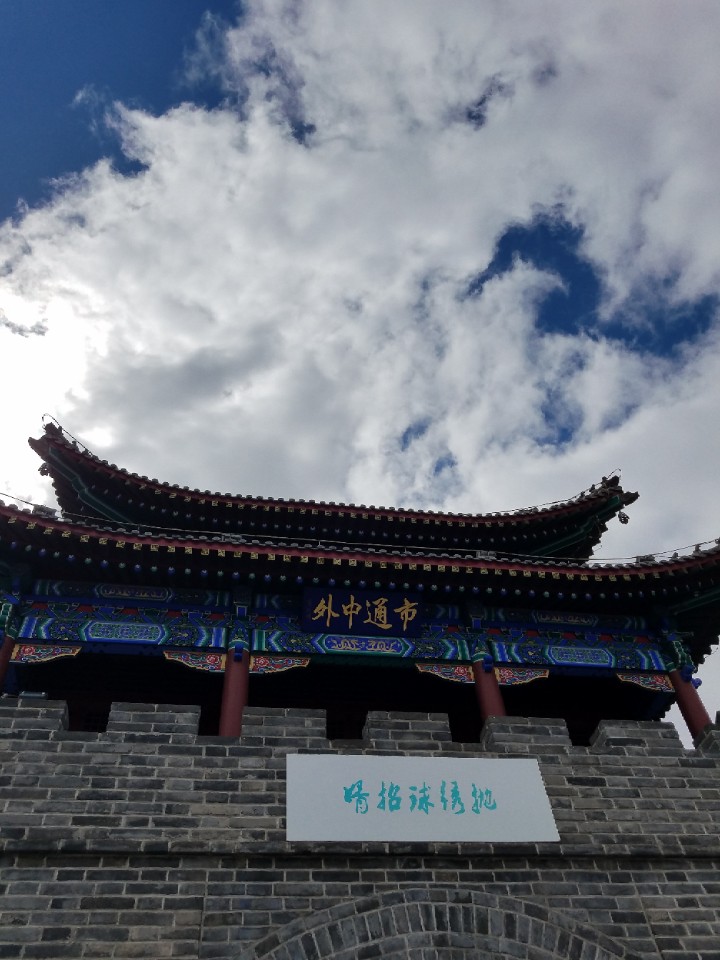
Dajing Gate exemplifies a classic stone arch-vaulted city gate structure, facing south and perched atop a cliff overlooking the Qingshui River, flanked by West Taiping Mountain and East Taiping Mountain, forming a natural defensive chokepoint.
Main Structural Features
- Gate Passage: 12 meters high, 9 meters wide, and 13 meters deep, constructed from massive granite slabs using a longitudinal joint technique for the arched roof, ensuring structural stability for over three centuries;
- Stone Inscription Plaque Above the Gate: The characters “Dajing Gate” were inscribed by General Danjin of the Chahar Commandery during the Qianlong era. The bold, powerful calligraphy remains clearly legible on the green stone lintel;
- Walled Enclosure Ruins: Remnants of the eastern and western enclosures survive, with recent archaeological surveys confirming their Qing-era layout, validating the military design of “one gate with two enclosures, controlling both mountains”;
- Great Wall Connection Section: A 300-meter stretch of Ming Dynasty brick-and-stone wall lies to the west of the gate, preserving sections of battlements and horse paths. The earthen rampart extending eastward to Hutaoshan Mountain is also part of the nationally protected “Ming Great Wall—Zhangjiakou Section.”
Key Associated Relics
- Inscription “Great Rivers and Mountains”: Located on the northern inner wall of the gate passage, this inscription was carved in 1933 by Song Zhe Yuan, then Governor of Chahar Province. The four characters, strong and solemn, express deep patriotic sentiment and serve as a symbolic emblem of the scenic area;
- Collection of Qing-Era Steles: Five inscribed stones are embedded in the eastern and western walls inside the gate, including excerpts from Record of Rebuilding Dajing Gate and Compendium of Chahar Province: Examination of Passes, detailing construction history and border trade systems from the Ming and Qing dynasties;
- Great Wall Museum (Dajing Gate Exhibition Hall): Housed in the former Qing military barracks, this permanent exhibition features the thematic display Great Wall: A Bond Between Peoples, systematically presenting the Great Wall’s roles in military defense, ethnic interaction, commerce, and cultural integration.
🌟 Cultural Significance: A Living Crossroads of Civilizations
Beyond its function as a military fortress, Dajing Gate embodies the living principle of harmony and coexistence within Chinese civilization:
- A "Peaceful Gateway" for Ethnic Integration: Unlike other gates designed primarily to repel invaders, Dajing Gate has long served as a hub for cross-border passage, trade, pilgrimage, and diplomatic missions. During the Qing dynasty, it hosted a customs office and a branch of the Ministry of Rites for Frontier Affairs, becoming a frontline administrative center for central government management of border regions;
- Eastern Node of Silk Road Civilization: As the starting point of the Zhangku Road, Dajing Gate facilitated the export of silk, tea, and porcelain, and the import of furs, livestock, and medicinal herbs, fostering deep cultural exchanges among Mongol, Han, Hui, and Manchu peoples and giving rise to a unique “port merchant culture”;
- Contemporary Interpretation of Great Wall Spirit: Its architectural philosophy—“open yet not unguarded, guarded yet open”—reflects ancient Chinese wisdom of “defending through harmony, securing borders through peace.” Recognized by UNESCO as the “Paradigm of Openness on the Eastern Great Wall.”
🎒 Visitor Tips
- Recommended Itinerary:
Main Gate Passage → Inner Wall Inscription “Great Rivers and Mountains” → Great Wall Museum → Western Ming Great Wall Ruin Trail → Qingshui River Viewing Platform (panoramic view of gate, river, and mountains) → Continue to explore Baozi Li Historic District (10-minute walk) - Special Experiences:
✅ Free guided tours offered daily at 9:30 AM and 3:00 PM (bilingual Chinese-English, requires on-site reservation);
✅ Annual “Zhangku Road Cultural Tourism Festival” held in spring and autumn, featuring intangible cultural heritage performances, camel caravan processions, and tea ceremony reenactments;
✅ Nighttime light show Gate Opens to the Mountains and Rivers (performed only during holidays and major festivals, combining holographic projections and live sound effects). - Visitor Notes:
⚠️ Some sections of the wall pathways feature steep slopes and stone steps—wear non-slip footwear;
⚠️ Climbing, carving, or taking rubbings on cultural relics is strictly prohibited;
⚠️ The scenic area features a “Great Wall Protection Volunteer Service Station,” where visitors can pick up bilingual guidebooks and AR-enabled scanning cards for interactive navigation.
🌐 Further Reading: Dajing Gate was designated a Hebei Provincial Cultural Heritage Site in 1982 and listed as a National Key Cultural Heritage Site in 2006 as part of the “Ming Great Wall” designation. In 2022, it was selected as one of the First Batch of Major Projects for the National Cultural Parks of the Yangtze River, Yellow River, Great Wall, and Long March by the State Administration of Cultural Heritage.
Mountains and rivers bear witness—this single gate has seen a thousand years of changing tides;
Merchants and travelers weave through—this one pass connects civilizations across north and south.