かほそぶむらふくとしやまじんだいじょう
ライウ💎💎💎
加载中...
📍 Address: Hepu Village, Jiyang District, Jinan City, Shandong Province
The Temple of the Lord of Land and Fortune in Hepu Village was originally constructed during the mid-Ming Dynasty, with a history spanning approximately 500 years. It stands as one of the better-preserved folk religious temples in the Jinan region. According to the "Record of Restoration" inscribed on a stone tablet within the village, the temple was initially built by local residents as a place for prayer and blessings, offering protection and peace to the community. Over the centuries, it has undergone multiple renovations, with the most significant reconstruction occurring during the Guangxu era of the Qing Dynasty. The temple bears witness to over five centuries of agrarian civilization and folk traditions in Hepu Village, serving as an important cultural symbol of rural social structure in northern Shandong.
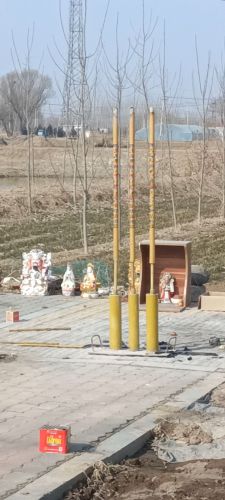
The temple faces south with its main structure oriented northward, covering an area of about 80 square meters. Built using traditional brick-wood construction, it features tiled eaves with upturned corners, reflecting the typical architectural style of northern Chinese residential temples. The main hall spans three bays wide and one bay deep, housing a clay statue of the "Lord of Land and Fortune." Flanking the central deity are statues of the Lady of Land and a youthful attendant. In front of the hall stands a stone incense altar, while two carved stone couplets from the Qing Dynasty are embedded on either side of the entrance gate: “Guarding the land and pacifying the people, blessed by heaven; Protecting the village and safeguarding the territory, winning the hearts of the people.” The calligraphy is bold and well-preserved.
As a tangible embodiment of grassroots folk belief, this temple embodies the Chinese philosophical concept of “great meaning in small shrines”—though modest in scale, it carries the simple hopes of ordinary people for safety, prosperity, and harmonious living. Its rituals continue to be observed today. Every year during the second day of the second lunar month—the birthday of the Lord of Land—villagers hold traditional ceremonies including deity welcoming, sacrificial rites, and dragon dances. These customs constitute an essential part of Jinan’s intangible cultural heritage.
🍃 A single incense stick, guarding through millennia; a patch of land, blessing countless homes. Hepu Village’s Temple of the Lord of Land and Fortune stands quietly amidst the countryside, whispering the most authentic spirit of faith across the Qilu region.