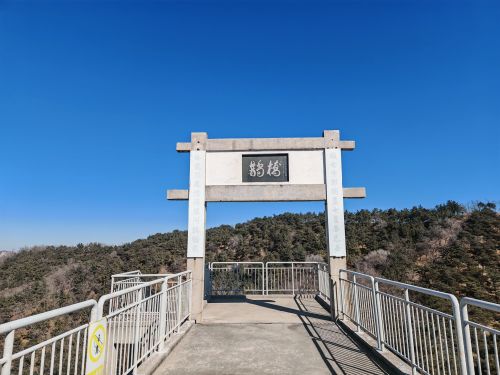
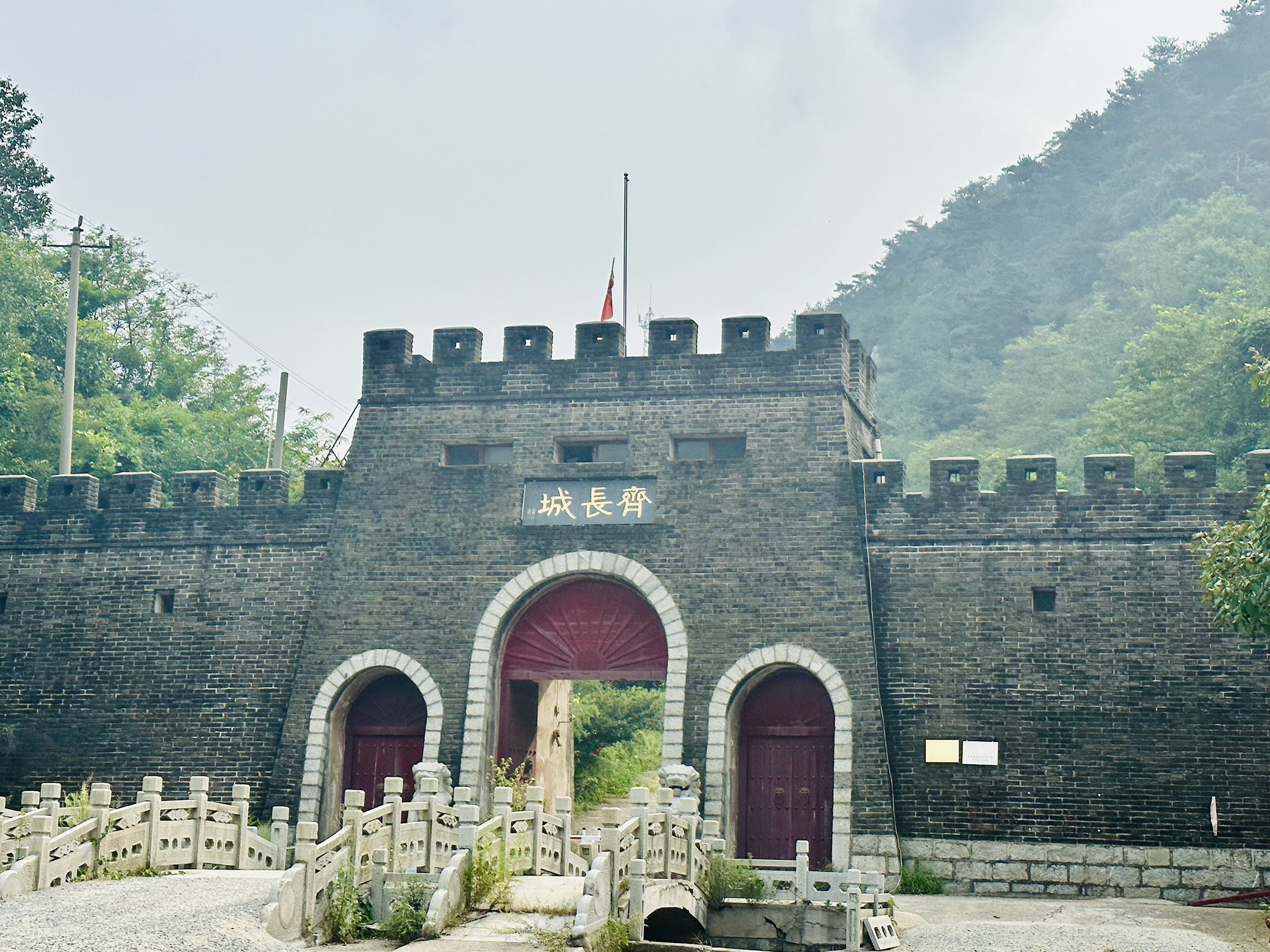
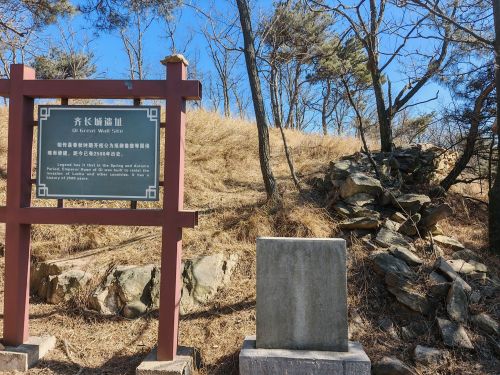
🏯 Qi Great Wall Ruins (Sijiaocheng Section, Dazhuang Town · Qixingtai Scenic Area)
📜 Historical Evolution
The Qi Great Wall is the oldest and most ancient surviving Great Wall relic in China, originally constructed during the Spring and Autumn Period (circa 7th century BCE) and completed in the middle of the Warring States Period (4th century BCE), with a history spanning over 2,600 years. Its original purpose was to “limit Lu and Wei, defend against Chu and Yue, and secure national borders,” forming the core of the military defense system built by the State of Qi using the natural barrier of the Tai-Yi mountain range.
- The Sijiaocheng section in Dazhuang Town represents a significant pass site along the central stretch of the Qi Great Wall. Located at the junction of the residual peaks of Mount Tai and the central Shandong hills, it controlled the strategic chokepoint of the ancient “Qilu Post Road”;
- Records from The Zuo Commentary, Records of the Grand Historian (Shiji), and the Qing Dynasty’s Comprehensive Gazetteer of Shandong indicate that this section underwent multiple reinforcements during the reigns of King Xuan and King Min of Qi. It remained functional for garrison duty in the Han Dynasty, but gradually lost its military role after the Northern and Southern Dynasties period, transitioning into a boundary marker and a common passage for local communities;
- Local chronicles from the Ming and Qing dynasties clearly document “Sijiaocheng” as a site of a Qi Great Wall fortress, named for its roughly square-shaped walls with watchtowers at each corner—distinct from later constructions.
🏗️ Current State and Architectural Features
This section lies in the northern foothills of Sijiaocheng Village, Dazhuang Town, Laiwu District, Jinan City (formerly Laiwu City), now under unified protection and management within the Qixingtai Scenic Area. It is designated as a National Key Cultural Relic Protection Unit (designated by the State Council in 2001, No. 5-369).
Main Remains:
- ✅ Wall Foundations: Approximately 1.2 kilometers of rammed earth foundations remain, with partial heights ranging from 1.8 to 3.2 meters and base widths of 8 to 12 meters. Constructed using the technique of “layered board-building with wooden poles inserted and compacted by pounding,” mixed with yellow soil and gravel, the cross-section reveals clear ramming layers (12–15 cm thick) and traces of mortise holes for structural timber;
- ✅ Sijiaocheng Fortress Ruin: The site has an irregular rectangular plan (about 180 meters east-west, 150 meters north-south). Foundations of the eastern, western, and northern walls still stand, while the southern wall has been completely buried. The remaining northern wall foundation reaches about 2.5 meters in height, and one fragment of a battlement platform remains on the eastern wall;
- ✅ Beacon Tower Ruin: A circular rammed earth platform measuring approximately 9 meters in diameter and 1.6 meters in height was discovered atop a high point northeast of Sijiaocheng (on the western slope of Qixingtai Peak). Artifacts found include fragments of late Warring States pottery bowls (dou), tripod legs (ge zhu), and gray earthenware tiles with cord-marked patterns, confirming its function as a signal tower integrated with the Qi Great Wall system;
- ✅ Ancient Road and Associated Facilities: A well-preserved ancient cart and horse track, about 3 meters wide, runs south of the wall. Two stone-lined drainage culverts were also uncovered along the route, corroborating the architectural wisdom described in Guanzi: On Measuring the Land—“Build high places without proximity to elevated terrain to ensure ample water supply, and avoid low-lying areas near rivers to reduce ditch maintenance.”
⚠️ Note: This section has not undergone large-scale reconstruction. All displays are based solely on archaeological surveys and conservation of original structures, strictly adhering to the principles of minimal intervention, recognizability, and reversibility in heritage restoration.
🏺 Archaeological Discoveries and Artifacts
Between 2013 and 2022, the Shandong Provincial Institute of Cultural Relics and Archaeology collaborated with the Jinan Municipal Institute of Archaeology to conduct systematic surveys and targeted excavations, yielding significant findings:
- Excavated fragments of fine gray clay roof tiles and tube tiles from the Warring States Period (decorated with coarse rope patterns and raised cord motifs), some with preserved cloud-pattern mold lines on tile ends;
- Discovered three bronze arrowheads (double-winged, narrow-bladed type typical of Qi military equipment) and one iron adze fragment (confirming the application of advanced iron smelting technology in border fortification during the late Warring States Period);
- Numerous ceramic rim fragments, tripod feet, and jar bases recovered from inside the fortress date to the late Spring and Autumn through early Warring States periods, with radiocarbon dating concentrated between 520–380 BCE;
- Phytolith analysis of rammed earth samples revealed traces of millet and broomcorn millet, supporting historical evidence of Qi’s “agriculture-first” frontier policy—soldiers cultivated land for self-sustenance.
🌟 Cultural Significance and Global Importance
- Chronological Benchmark: Predating the Qin Great Wall by nearly 400 years, it serves as a living specimen for studying the evolution of China’s early state defense systems;
- Engineering Excellence: Embodies the pre-Qin principle of “adapting to terrain and utilizing natural advantages to block enemy advances” (Shiji: Genealogy of Chu), with rammed earth construction techniques matching the world’s leading standards of the era;
- Cultural Dialogue Witness: As a spatial embodiment of Qi culture’s values—“respecting talent, valuing achievement, pragmatic innovation”—it forms a cultural axis alongside Qufu’s Lu State capital and Linzi’s Qi State capital, completing the symbolic framework of “One Mountain, One River, One Sage” with the new triad of “One Wall, One Lineage, One Spirit”;
- Model of Ecological-Humanistic Harmony: The wall’s alignment closely follows the contour lines of the Tai Mountains, reflecting ancient wisdom of “harmony between humanity and nature” in territorial planning. It has been cited as a model case in UNESCO’s Guidelines for Asian Great Wall Heritage Conservation.
🧭 Travel Information
| Item | Details |
|---|
| 📍 Location | North of Sijiaocheng Village, Dazhuang Town, Laiwu District, Jinan City, Shandong Province, within the Qixingtai Scenic Area (use navigation: “Qi Great Wall Sijiaocheng Ruins”) |
| 🎫 Admission | Included in Qixingtai Scenic Area ticket (¥60 for adults, ¥30 for students/seniors with valid ID); closed every Monday (except public holidays) |
| ⏰ Opening Hours | 08:00–17:00 (last entry at 16:30) |
| 🚌 Transportation | • By car: Jinan urban area → Laiwu North Exit on Jinghu Expressway → Provincial Road S243 → Dazhuang Town → Sijiaocheng Village (approx. 1.5 hours) <br>• Public transit: Take a bus from Jinan Long-Distance Bus Terminal to Dazhuang (6 daily departures) → alight at Dazhuang Town → transfer to local bus or walk 3 km to the site entrance |
| 🥾 Visitor Tips | • The core ruins feature wooden walkways and panoramic interpretive panels; climbing, rubbing, or carving on walls is strictly prohibited; <br>• Recommended route: Visitor Center → Qi Great Wall Culture Exhibition Hall (featuring digital reconstruction sand table) → Sijiaocheng Fortress Ruin → Beacon Tower Viewing Platform → Ancient Path Experience Trail (2.3 km loop); <br>• Professional guided tours available (must be booked in advance); AR-guided mobile app provided (scan QR code to view 3D reconstructions of ramming layers and watchtowers on-site). |
🌿 Visitor Reminder: The site lies in an ecologically sensitive zone. Please comply with the Great Wall Protection Regulations—do not move stones or collect soil—to jointly preserve this 2,600-year-old imprint of civilization.