🏯 Cemetery Pagoda Grove | Core Cultural Heritage Site of the Si Men Ta Scenic Area
"Tall pagodas cast uneven shadows on ancient trees, stone steps lead silently into the blue sky."
—— One of China’s largest and best-preserved collections of Buddhist monastic tombs spanning the Sui-Tang to Ming-Qing dynasties, a vital material testament to the cultural legacy of Chan Buddhism’s ancestral temple.
📍 Basic Information
- Name: Cemetery Pagoda Grove (also known as "Shentong Temple Pagoda Grove")
- Address: No. 55, Sujiazhuang, Liubu Subdistrict, Licheng District, Jinan City, Shandong Province · Located within the Si Men Ta Scenic Area (about 300 meters northeast of Si Men Ta, nestled in a mountain hollow)
- Management Authority: Jinan Culture & Tourism Development Group Co., Ltd. (uniformly managed under the Si Men Ta scenic zone)
- Protection Status:
- National Key Cultural Relics Protection Unit (listed in the first batch of national protected sites in 1961, alongside Si Men Ta, Longhu Ta, and Jiuding Ta)
- Key component of Shandong Province’s first batch of Historic and Cultural Villages (Liu Bu area)
📜 Historical Evolution
The Cemetery Pagoda Grove was originally established during the Sui Dynasty, flourished through the Tang, Song, Jin, and Yuan Dynasties, and continued into the Ming and Qing Dynasties, serving as the burial site for high-ranking monks of the former Shentong Temple, where their relics were enshrined and their spiritual merits commemorated after death.
- Foundations in Sui-Tang: Shentong Temple was founded in the first year of Qianqin Huangshi (351 AD). During the Kaihuang era of the Sui Dynasty (581–600), the temple reached its peak, with the first monk tombs erected. The earliest dated pagoda still standing is the Hui Chong Chan Master’s Pagoda from the 24th year of Tang Kaiyuan (736 AD).
- Prosperity in Song-Jin: The Continued Biographies of Eminent Monks from the Northern Song Dynasty records “over a thousand monks at Shentong Temple, with a hundred pagodas in the grove.” Surviving Song Dynasty foundations and inscribed steles confirm this; Jin Dynasty restoration records are preserved in inscriptions on the pagoda bodies (e.g., the stele dated the 9th year of Dading, 1169 AD).
- Continued Construction in Yuan-Ming: Yuan Dynasty pagodas adopted simpler forms, mostly with dense eaves; Ming Dynasty saw the emergence of brick-built pavilion-style pagodas imitating wooden architecture, accompanied by the erection of steles recording the lineage of past patriarchs.
- Decline and Rediscovery: By the late Qing and early Republican periods, the temple declined and the pagoda grove gradually became overgrown. Its significance was confirmed during a 1953 cultural heritage survey. In 2006, it was reopened as part of the comprehensive renovation of the Si Men Ta Scenic Area.
🏗️ Architectural and Cultural Features
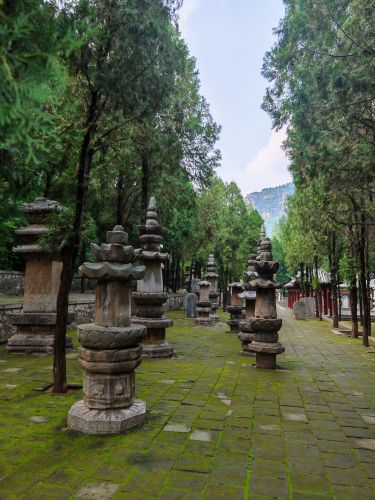
The Cemetery Pagoda Grove is naturally arranged along the slope, forming a fan-shaped layout on a gentle terraced hillside. It currently preserves 44 distinct tombs and pagodas (including 12 ruined foundations), spanning seven dynasties from the Sui to the Qing—a time span exceeding 1,300 years—making it a living textbook of the evolution of Chinese funerary pagodas.
🔹 Major Pagoda Types and Representative Remains
| Dynasty | Pagoda Characteristics | Representative Example | Cultural Value |
|---|
| Sui–Early Tang | Single-story pavilion style, square base, hemispherical dome, plain surface without ornamentation | Uninscribed Sui Pagoda (ruined) (only base remains) | One of the earliest surviving examples of Chinese tomb pagoda form |
| High Tang | Square single-story pavilion style, corbelled eaves, inscribed sutras or epitaphs carved on the body | Hui Chong Chan Master’s Pagoda (736 AD): Inscribed with excerpts from the Diamond Sutra, elegant regular script | Paradigm of Tang Buddhist calligraphy and epigraphic tradition |
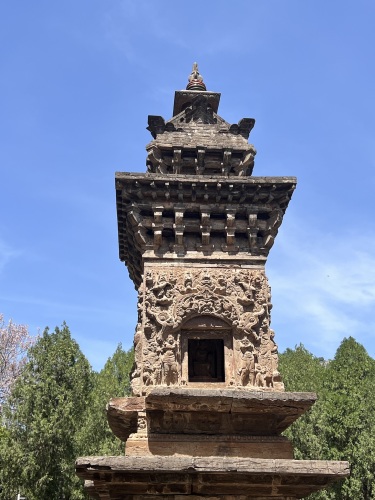
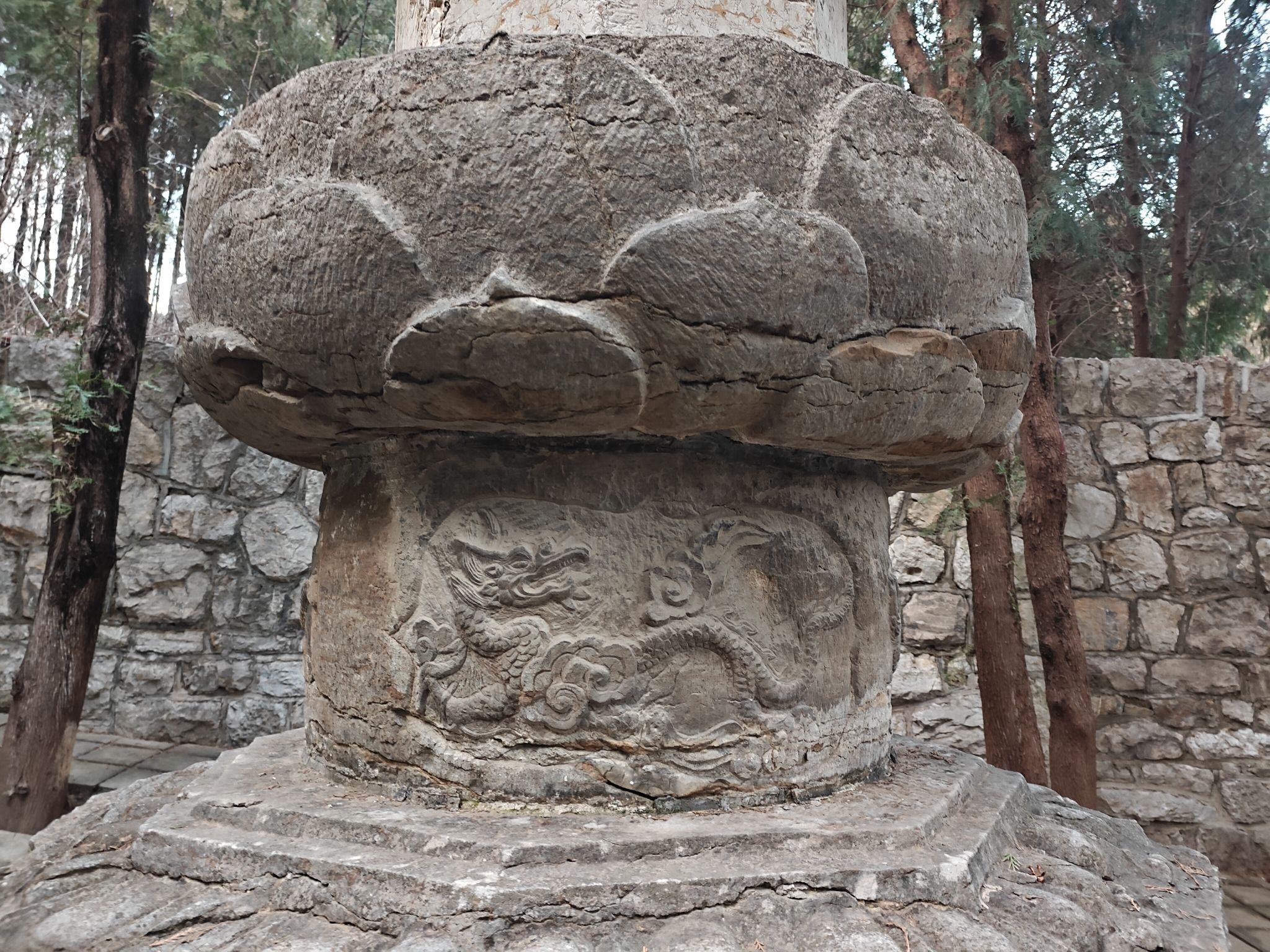
| Northern Song | Octagonal pavilion style, finely carved wooden-style brackets and windows | Dao Shen Chan Master’s Pagoda (1080 AD): Octagonal pedestal with lotus-bud base, relief carvings of auspicious beasts inside arched niches, seal script on the lintel | Peak achievement in stone craftsmanship in Shandong during the Song Dynasty |
| Jin Dynasty | Predominantly dense-eaved style, pronounced tapering profile, frequently inscribed with dates | Dading Ninth Year Pagoda (1169 AD): Carved with “Year Ji Chou of Dading Ninth Year” and donor list | Primary historical source on Jin-era Buddhist activities and folk beliefs in Shandong |
| Ming Dynasty | Increased number of pavilion-style brick pagodas, some with enclosing walls and pavilions | Pu Zhao Chan Master’s Pagoda (Wanli period, Ming): Three-tiered pavilion style, intricately carved brick brackets, one stele with tortoise base preserved in front | Reflects the revival of Chan Buddhism and local gentry patronage traditions in the Ming |
🔹 Other Significant Cultural Relics
- Two Tang Dynasty Steles: Inscription and Preface to the Tomb of Master Hui Chong of Shentong Temple, Great Tang (736 AD) and Inscription to the Tomb of Master Dao Shen, Great Sage of Shentong Temple (1080 AD), both rare intact Tang-Song-era tomb inscriptions in Shandong.
- Song Dynasty Stone Carvings: Lotus-petal column bases and warrior reliefs scattered around the edges of the grove, attesting to Song-era temple architectural standards.
- Qing Dynasty Stele: "Record of the Restoration of Shentong Temple Pagoda Grove" (1742 AD): A detailed account of the grove’s damage and repair history across generations, holding significant documentary value.
🌿 Cultural and Academic Significance
- Geographical Anchor of Chan Transmission: As the affiliated pagoda grove of Shentong Temple—the earliest Chan Buddhist site in Shandong—it provides tangible evidence of Chan Buddhism’s transmission from the Northern Wei to the Qing Dynasty across the heartland of Qilu. Alongside the pagoda groves of Shaolin Temple and Lingyan Temple, it ranks among the “Three Great Northern Chan Pagoda Groves.”
- Chronological Benchmark for Ancient Architecture: The 44 pagodas represent seven dynastic styles—from the simple Sui-Tang hemispherical domes to the intricate Song-Jin wooden-style imitations, culminating in Ming-Qing fusion of brick and stone—forming a complete sequence of small-scale stone pagoda evolution in northern China.
- Treasure Trove of Stone Carving Art: Pagoda inscriptions feature diverse scripts including Tang regular script, Song seal script, Jin clerical, and Ming running script. Relief themes include flying apsaras, Garuda birds, scrolling peonies, and classical motifs, reflecting evolving aesthetic sensibilities and religious ideas across eras.
- Model of Ecological and Humanistic Harmony: Together with Si Men Ta, Longhu Ta, and Jiuding Ta, the pagoda grove forms the “Liu Bu Ancient Architectural Cluster,” surrounded by ancient trees (a thousand-year-old Chinese fir and cypress), creating the classic mountain temple landscape of “pagodas hidden in forests, forests sheltering quiet towers.” Recognized in 2019 as an exemplary case of ecological conservation in China’s scenic areas.
🧭 Visitor Guide
✅ Opening Information
- Opening Hours:
- April–October: 07:30–17:30 (last entry at 17:00)
- November–March: 08:00–17:00 (last entry at 16:30)
- Ticket Policy:
- Included in the Si Men Ta Scenic Area Combined Ticket (¥35 per person; half-price for students and seniors with valid ID)
- Free audio guide rental available (deposit ¥100); group tours with professional cultural heritage guides can be booked (must reserve 3 days in advance)
🚶♂️ Recommended Tour Route
- Main Entrance → Si Men Ta (the first stone pagoda of the Sui Dynasty—essential viewing)
- Eastern Trail from Si Men Ta → Cemetery Pagoda Grove (approximately 5-minute stone path, with historical interpretation panels along the way)
- Core Area of the Pagoda Grove: Focus on three clearly dated pagodas—Hui Chong (Tang), Dao Shen (Song), and Dading (Jin)
- Extended Exploration: A trail westward leads to Longhu Ta (Tang Dynasty, masterpiece of stone carving) and Jiuding Ta (Tang Dynasty, rare multi-turreted structure)
📸 Special Tips
- Respect religious sanctity: Do not climb the pagodas or touch inscriptions; flash photography is prohibited within the grove.
- Best Viewing Seasons: April (cherry blossoms framing the pagodas) and September–October (ginkgo leaves turning gold, maple woods ablaze red)—offering the most poetic interplay of light and shadow.
- Academic Support: The Jinan Archaeological Research Institute conducts ongoing 3D scanning and inscription rubbings of the pagodas; findings are published on the “Shandong Grottoes and Pagoda Grove Digital Archive Platform.”
🌟 Closing Reflection: The Cemetery Pagoda Grove is more than a silent row of stone towers—it is a millennium-long chronicle etched into rock, a lantern of Chan wisdom burning through time. Every chisel mark is a stroke of history; every shadow cast by a pagoda bears the imprint of faith. Step into this sacred space, and you enter a profound, enduring chapter in the journey of Buddhism’s localization in China—bold yet tender, ancient yet alive.