Tianhou Temple (Xiqing District, Tianjin)
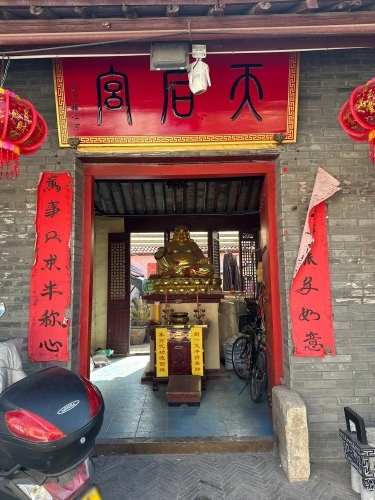
Address
建设西路与新河北路交叉口西180米
Description
🌊 Tianhou Temple (Xiqing District, Tianjin)
"The sea lies calm as a thousand ships gather; the heavens bestow auspicious clouds, bringing peace to ten thousand people."
—— Inscription on the Qing Dynasty restoration stele
📍 Basic Information
- Official Name: Xiqing District Tianhou Temple (commonly known as "Yangliuqing Tianhou Temple" in local tradition)
- Location: 180 meters west of the intersection of Jian She West Road and Xinhe North Road, Xiqing District, Tianjin (adjacent to the core conservation zone of Yangliuqing Ancient Town)
- Current Layout: A complete temple complex rebuilt during the Qing Dynasty, with subsequent renovations in the Republican era and the 21st century
- Conservation Status: Protected cultural site at the municipal level in Tianjin (designated in 2009), an essential component of the Yangliuqing Ancient Town Historic Cultural District
⏳ Historical Development
Tianhou Temple was originally constructed in the second year of the Yongle reign of the Ming Dynasty (1404), built in gratitude for the prosperity of river transport and prayers for safety. Its historical lineage is well-documented:
- ✅ Ming Dynasty Foundation: With the establishment of Yangliuqing as a key relay station along the Grand Canal, the town flourished as a commercial hub. Merchants and devotees pooled resources to build a temple dedicated to Tianhou (Mazu);
- ✅ Qing Dynasty Restoration (39th year of Kangxi’s reign, 1700): The current main architectural foundation, stone steps, parts of the wooden beams, and the Record of the Restoration of Tianhou Temple are all surviving relics from this renovation;
- ✅ Major Expansion (24th year of Guangxu’s reign, 1898): Additional structures such as a performance stage, side halls, and the main gate were added, forming the classic northern Chinese temple layout of “one central axis, three courtyards, symmetrical east-west wings”;
- ✅ Comprehensive Restoration (2006–2008): Based on the China Conservation Guidelines for Cultural Heritage Sites, traditional craftsmanship was used to restore polychrome paintings, roof tiles, and timber frameworks, strictly preserving the formal characteristics of Qing imperial architecture.
📜 Key Physical Evidence: Two Qing Dynasty steles remain within the temple compound:
- Record of the Restoration of Tianhou Temple (1701, 40th year of Kangxi), which details donor merchant guilds and vividly describes the bustling scene of “ships lining up like fish scales, sails shading the sky”;
- Stele on the Rebuilding of Tianhou Temple (1898, 24th year of Guangxu), clearly stating that “the old Tianhou Palace in Yangliuqing has existed since the Yongle era, spanning five centuries.”
🏯 Architectural Features
Covering approximately 1,800 square meters, the temple faces south with a symmetrical axial layout, exemplifying the typical fusion of Qing-era Daoist temple design and folk religious practice in northern China:
| Architectural Section | Description | Cultural Significance | |-----------------------|-------------|------------------------| | Main Gate (Mountain Gate) | Hard-tiled gabled roof with glazed bricks and tiles; the gate lintel bears a carved stone plaque inscribed with the words “Tianhou Temple” in regular script (original from the Guangxu period) | “Tianhou” is the highest official title bestowed upon Mazu by the Qing court, reflecting state recognition of the deity’s sacred status | | Front Hall (Hall of the Four Heavenly Kings) | Three bays wide, housing statues of the Four Heavenly Kings; beam and rafter surfaces feature ink-line small-golden polychrome painting, preserving the appearance of mid-Qing dynasty original work | Integrates Buddhist guardian deities into folk belief, demonstrating religious inclusivity | | Main Hall (Hall of Tianhou) | The central structure, five bays wide with a hip roof and projecting porch; interior features a seated clay statue of the Holy Mother Tianhou (2.8 meters tall, reconstructed in 1983 based on a Qing Guangxu-era photograph) | The ceiling coffered panel depicts the “Peaceful Rivers and Calm Seas” mural, symbolizing safe navigation and favorable weather for river trade | | Rear Hall (Guanyin Pavilion) | Two-story pavilion-style building; lower level enshrines Guanyin, upper level honors Bi Xia Yuanjun; reflects the regional practice of “Three Teachings Unified” faith | Illustrates how Mazu worship adapted locally in inland canal towns | | Performance Stage | Located in the eastern wing courtyard, single-eaved curved roof with western-facing stage opening opposite the main hall; column bases carved with “Fish Leaping Over the Dragon Gate,” rail panels featuring “Eight Immortals Crossing the Sea” relief carvings | Preserves the tradition of ritual performances during seasonal festivals; one of the best-preserved county-level Qing dynasty performance stages still extant in Tianjin |
🏺 Significant Cultural Relics and Exhibits
- One Qing Dynasty Bronze Bell (cast in 1703, 42nd year of Kangxi): Weighing about 420 kilograms, inscribed with “favorable weather, national peace and prosperity,” its deep, resonant tone makes it among the oldest existing temple bells associated with Mazu temples in Tianjin;
- Pair of Iron Incense Burners from the Qianlong Period: Placed on the moon platform before the main hall, inscribed with “Devotees from Xiqing County, Yangliuqing Town, Tianjin Prefecture,” confirming the role of local civic organizations in temple administration during the Qing era;
- Stele of Temple Regulations (8th year of Daoguang’s reign): Clearly documents temple landholdings, ritual procedures, and rotating stewardship systems by merchant guilds—key evidence for studying self-governance in Qing-era canal-based commercial society;
- Silk Scroll Painting: Procession of the Holy Mother Tianhou (preserved at Xiqing District Archives): Depicts the grand festival scene during the Guangxu era, including ceremonial processions, folk performances, and model cargo boats—core visual documentation of the nationally recognized intangible cultural heritage “Yangliuqing Temple Fair.”
🌟 Cultural Significance
- Living Testament to Canal Civilization: As a related heritage site of the Grand Canal (Tianjin section), a UNESCO World Heritage Site, it provides tangible proof of the transmission of goods, beliefs, and art along the canal during the Ming and Qing dynasties;
- Paradigm of Mazu Faith’s Northern Spread: Successfully transcended coastal boundaries to establish a stable religious center in inland canal cities, transforming the “Goddess of the Sea” into a “Guardian of Waterways” and “Protector of the Community”;
- Cultural DNA Repository of Tianjin: Continues the long-standing tradition of the “March 23rd Festival” honoring Tianhou’s birthday (listed in Tianjin’s Intangible Cultural Heritage Register), with vibrant customs including dragon dances, drum rituals, and exhibitions of Yangliuqing New Year pictures;
- Architectural Benchmark for Historical Study: Represents a refined adaptation of Qing imperial construction standards in vernacular temples, particularly distinguished in polychrome painting techniques, brick carving craftsmanship, and acoustic design of performance stages.
🧭 Visitor Guide
- Opening Hours: 8:30 AM – 5:00 PM daily (closed on Mondays, except public holidays)
- Admission: Free entry (requires valid ID registration upon arrival)
- Recommended Visit Duration: 1.5 to 2 hours
- Guided Services:
- Official audio guide mini-program (scan QR code for instant access, available in both Chinese and English with explanations of architectural terms);
- Two free public lectures daily at 10:00 AM and 2:00 PM (led by certified instructors from Xiqing District’s Intangible Cultural Heritage Protection Center);
- Nearby Attractions:
- 3-minute walk → Yangliuqing Ancient Town Main Street (including the Shi Mansion and An Mansion);
- 5-minute walk → Belt of the Grand Canal at Yangliuqing (featuring thematic relief sculptures depicting canal culture);
- Exit at B entrance of Yangliuqing Station on Line 2 of the Metro, proceed west along Jian She West Road, then turn right onto Xinhe North Road to reach the temple.
🌙 Visitor Tips:
- Flash photography is prohibited inside the temple when capturing deities or ancient painted murals;
- Expect heavy crowds during the temple fair (around Lunar March 23); consider visiting off-peak times;
- Respect religious etiquette: remain quiet during worship, and burn incense only in designated urns.
Tianhou Temple is more than just a local shrine—it stands as a spiritual riverbed shaped by a millennium of the Grand Canal’s flow. Silent and enduring, it uses bricks and stones as parchment, incense smoke as ink, continuing the timeless narrative of Tianjin’s people honoring heaven and ancestors, standing together in mutual care and protection.